

Yes. Private investment gains generally count toward net investment income, and in 2026 the 3.8% net investment income tax applies to the smaller of your net investment income or your modified adjusted gross income above the applicable filing-status threshold. This tax is separate from regular federal income tax, and private ownership does not create an exemption; certain nonpassive business gains, retirement-account income, and other statutory exclusions require different treatment.
- Private investment gains: net investment income tax generally applies when recognized gains and income exceed the applicable thresholds.
- The IRS applies a 3.8% rate to the smaller of net investment income or income above your filing-status threshold.
- Private fund distributions, partnership gains, and stock sales require different tax classifications; cash received is not automatically taxable gain.
- Material participation does not automatically exclude portfolio interest, dividends, or gains from investment securities.
Do private investment gains count toward the net investment income tax?
Recognized gains from private investments generally enter the net investment income calculation unless a specific exclusion applies. The controlling questions are what generated the income, whether the gain is recognized for federal tax purposes, and whether your modified adjusted gross income exceeds the threshold.
Internal Revenue Code Section 1411 establishes the tax. IRS Topic No. 559 and the Instructions for Form 8960 explain its application to individuals, estates, and trusts; this guide addresses individuals under the rules applicable in 2026.
Start by connecting brokerage statements to a tax-smart investment plan, then add private-investment records that do not appear on brokerage statements.
| Investment or income type | General NIIT treatment | Main qualification |
|---|---|---|
| Gain from selling privately held investment stock | Generally included | Private ownership does not itself provide an exclusion |
| Interest and dividends from private investments | Generally included | Working in a business does not automatically exclude portfolio income |
| Passive partnership or fund income | Generally included | Use the underlying income character and applicable passive-activity rules |
| Gain from assets used in a qualifying nonpassive business | Generally excluded | The business must satisfy the applicable NIIT exclusion |
| Gain from selling a partnership or S corporation interest | Requires a special calculation | Material participation alone does not resolve the entire sale |
| Qualified retirement-plan or IRA distributions | Excluded from net investment income | Taxable distributions can still increase modified adjusted gross income |
These categories describe tax treatment, not investment quality. A favorable NIIT result does not establish that an investment suits your risk tolerance, liquidity needs, or financial goals.
Why this matters
A private investment can create taxable income without sending you enough cash to cover the tax. A partnership allocation, for example, can produce reportable income even when the partnership retains the related cash.
The opposite also occurs: a cash distribution is not necessarily taxable income. Separate the investment's income allocation, cash distribution, and sale proceeds before calculating NIIT. Treating them as interchangeable creates errors in both directions.
For 2026 planning, review expected wages, business income, retirement distributions, and investment gains together. An investment cannot be evaluated for NIIT solely by looking at its own return.
The NIIT rate: 3.8%
The net investment income tax rate is 3.8%. It applies to the lesser of net investment income or the amount by which modified adjusted gross income exceeds your filing-status threshold.
That means crossing the threshold does not automatically subject every dollar of investment income to NIIT. Conversely, substantial wages can push you above the threshold even though wages themselves are not net investment income.
Use Form 8960 to determine the tax. Do not simply multiply your gross sale proceeds by 3.8%; proceeds are not the same as gain, and gain is not necessarily the final net investment income amount.
Single or head of household: $200,000 threshold
For a single filer or head of household, the modified adjusted gross income threshold is $200,000. Net investment income alone does not trigger the tax when modified adjusted gross income does not exceed that threshold.
Married filing jointly: $250,000 threshold
For married taxpayers filing jointly, the threshold is $250,000. Both spouses' relevant income enters the joint-return calculation, so review the household's income rather than the investment owner's income alone.
Married filing separately: $125,000 threshold
For married taxpayers filing separately, the threshold is $125,000. Filing separately does not create a general NIIT exemption and changes other tax calculations as well.
Qualifying surviving spouse: $250,000 threshold
For a qualifying surviving spouse, the threshold is $250,000. Confirm that you qualify for this filing status rather than assuming that the joint-return threshold remains available.
These individual thresholds are not indexed for inflation. The same statutory amounts apply in 2026; estates and trusts follow different threshold rules.
How to classify private investment income before calculating NIIT
Follow the income from the underlying transaction to the tax return. The investment's marketing label—private equity, private credit, or real estate fund—does not replace that analysis.
- Identify income. Separate interest, dividends, capital gains, operating income, and cash distributions. A single investment can generate several categories.
- Verify basis. Reconcile purchase records, prior adjustments, and relevant partnership information. Gross proceeds do not establish your taxable gain.
- Check participation. Determine whether a business activity is passive under the applicable rules. Keep evidence supporting any material-participation position.
- Apply exclusions. Review retirement-account treatment, qualifying nonpassive business income, and transaction-specific rules before totaling net investment income.
- Calculate NIIT. Apply allowable deductions and the modified-adjusted-gross-income limitation using Form 8960 and its instructions.
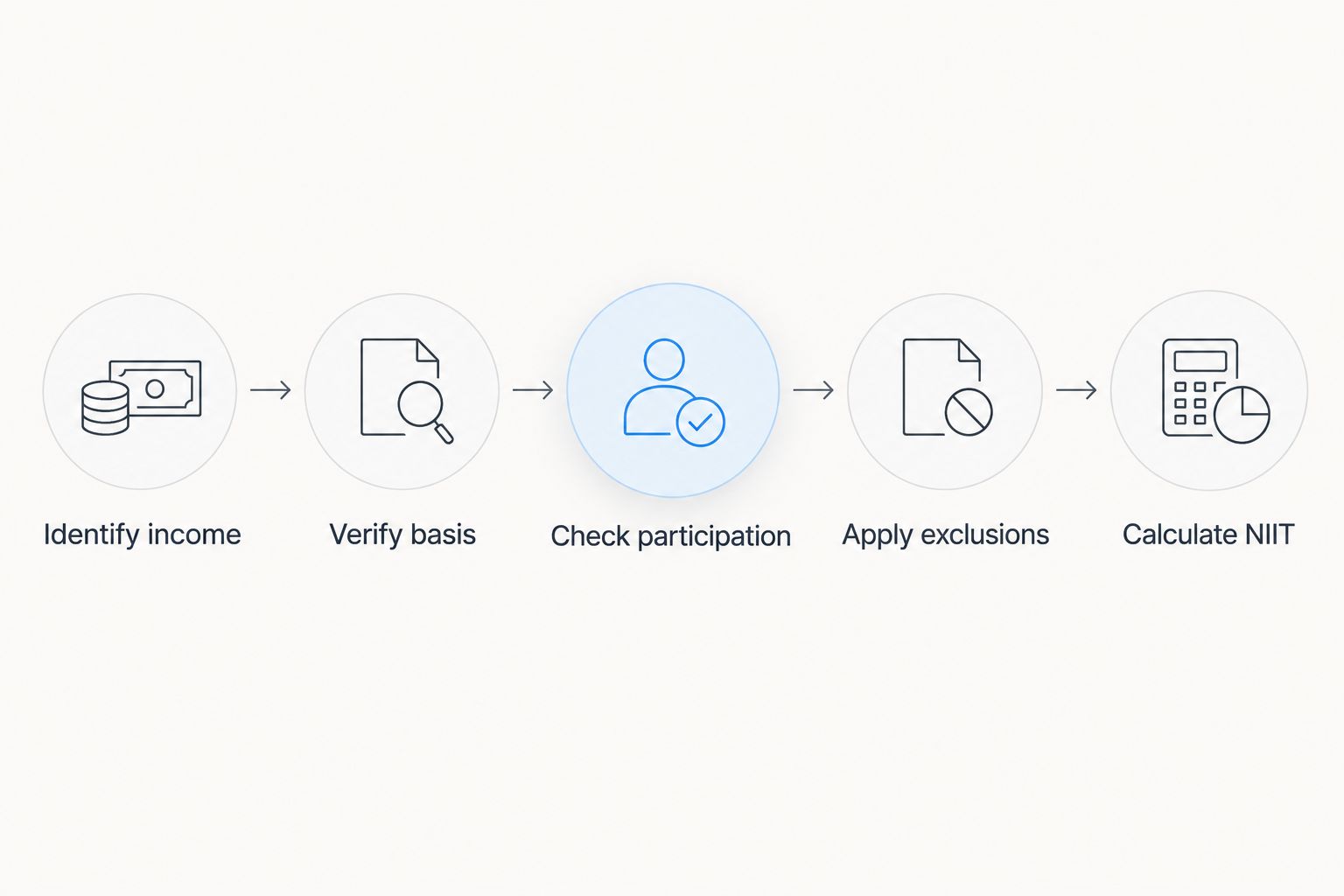
For a 2026 review, collect investment statements, Schedules K-1 and supporting statements, sale agreements, basis schedules, and relevant prior returns. Request missing tax information before deciding that a distribution is taxable or that a business sale is excluded.
The Rutter Organization serves individuals and businesses through tax resolution services alongside its private investment, real estate, and media activities. The Rutter Organization is a fit for individuals and businesses seeking tax resolution services. A private-investment gain, by itself, does not establish that you have a tax-resolution problem.
If an unresolved tax matter accompanies the investment issue, review The Rutter Organization for the organization's stated services. Keep the immediate reporting question separate from any existing tax debt or notice.
Why private investment NIIT exposure varies
The 3.8% rate stays the same, but the amount subject to it depends on the return and the transaction. Review these factors before estimating your liability:
- Income character. Interest, dividends, operating income, and recognized gains follow different inclusion and exclusion rules.
- Modified adjusted gross income. Wages and taxable retirement distributions can increase the threshold excess without becoming net investment income themselves.
- Filing status. The applicable threshold changes between single, joint, and separate returns.
- Participation and business activity. Certain nonpassive trade or business income is excluded, but portfolio income does not automatically receive that treatment.
- Basis, losses, and deductions. Correct basis and properly allowable investment-related deductions affect the calculation; loss limitations still apply.
- Transaction structure and timing. An asset sale, an ownership-interest sale, and an installment transaction require different analysis of recognized income.
An exclusion must match the income—not just the owner's involvement. A taxpayer can materially participate in an operating business while still receiving investment income subject to NIIT.
Does selling private company stock trigger NIIT?
3.8% NIIT generally applies to recognized gain from private company investment stock when the income-threshold calculation produces a taxable amount. Long-term capital-gain treatment does not itself remove the gain from NIIT.
Working for a C corporation does not automatically exclude gain from selling its shares. Review any applicable statutory exclusion separately; excluded gain is not treated the same as recognized taxable gain.
Do private fund distributions count as investment income?
3.8% NIIT applies to included income, not automatically to the cash distributed by a private fund. For a partnership fund, review Schedule K-1 and its supporting statements to identify the income allocated to you.
A distribution can reduce basis rather than create current taxable income, while certain distributions exceeding basis can trigger gain. Do not label the full distribution as either taxable income or tax-free return of capital without reconciling the records.
Does material participation eliminate NIIT on a business sale?
3.8% NIIT is not automatically eliminated by material participation. Gains from assets used in a qualifying nonpassive business generally receive different treatment from investment assets, and sales of partnership or S corporation interests require special rules.
Before signing a sale agreement, identify what is being sold and request the information needed for the NIIT calculation. An ownership-interest sale cannot be classified solely by the number of hours you worked in the business.
Which planning steps help—and where are the limits?
Best for avoiding reporting errors: reconcile basis and income character first. This establishes the calculation without requiring an investment sale. The limitation is practical: incomplete historical records or delayed partnership information can prevent a reliable estimate.
Best for evaluating a planned exit: model the transaction before signing. Review sale structure, recognized gain, other household income, and any applicable exclusions together. Tax treatment is only part of the decision; contractual obligations and investment risk still matter.
Best for managing taxable investment gains: review usable losses. Recognized capital losses can affect net capital gain, but basis, at-risk, passive-activity, and other limitations determine which losses are deductible. An economic loss is not automatically a currently deductible tax loss.
Best for comparing account treatment: review eligible retirement accounts separately. Qualified retirement-plan and IRA distributions are excluded from net investment income, but taxable distributions can raise modified adjusted gross income. Account eligibility, prohibited-transaction rules, and investment restrictions remain separate concerns.
Before changing a 2026 transaction, compare the full federal tax result rather than NIIT alone. A strategy that reduces NIIT can still create other taxes or financial disadvantages.
FAQ
Do private investment gains always trigger net investment income tax?
No. Private investment gains generally enter net investment income, but the 3.8% tax depends on recognized income, applicable exclusions, and modified adjusted gross income above your filing-status threshold.
What income threshold applies to NIIT in 2026?
The 2026 thresholds are $200,000 for single or head-of-household filers, $250,000 for married filing jointly or qualifying surviving spouses, and $125,000 for married filing separately. The tax applies to the smaller of net investment income or modified adjusted gross income above the applicable threshold.
Can wages make my private investment gains subject to NIIT?
Yes. Wages are excluded from net investment income but generally increase modified adjusted gross income, which can expose investment income to NIIT.
Do unrealized private investment gains count toward NIIT?
Generally, no. An increase in an investment's estimated value is not itself recognized taxable gain, although special recognition rules require separate review.
Does holding an investment for more than a year avoid NIIT?
No. Long-term capital-gain treatment does not itself exempt recognized gain from the 3.8% net investment income tax.
Are rental property gains included in net investment income?
Rental property gains are generally included unless an applicable exclusion applies. Real estate professional status alone does not automatically establish that every rental item is excluded; material participation and the relevant trade or business rules also matter.
Do IRA withdrawals count as net investment income?
IRA distributions are excluded from net investment income. Taxable withdrawals can still raise modified adjusted gross income and increase NIIT exposure on separate investment income.
Which form reports the net investment income tax?
Form 8960 calculates the net investment income tax for individuals, estates, and trusts. For private investments, use the relevant Schedules K-1, sale records, basis schedules, and supporting tax statements to prepare the calculation.
One last thing
A retirement withdrawal can increase the tax on a completely separate private investment. The withdrawal is excluded from net investment income, but its taxable portion can increase the income used to test your threshold.
Before finalizing a 2026 investment exit, put the expected gain and other household income into the same calculation. Reviewing each item in isolation misses the interaction that determines your NIIT exposure.


