

No. An IRS CP2000 notice does not mean you are being audited; it proposes changes because information reported to the IRS does not match your tax return. In 2026, treat it as a request to review and respond—not a final bill, and not proof that the proposed tax is correct.
- Does CP2000 notice mean audit? No. The IRS proposes changes after identifying a mismatch with third-party information.
- Check the disputed income against your filed return before agreeing to additional tax.
- Use the response deadline printed on your notice; do not substitute a general deadline.
- Rutter Organization provides tax resolution services for individuals and businesses seeking help with tax issues.
Why this matters: A proposed adjustment and an assessed tax debt are different stages. Your response gives the IRS evidence to accept, revise, or withdraw its proposal. Start with the CP2000 response deadline guide, then work through the disputed items rather than assuming the entire notice is right.
Does an IRS CP2000 notice mean I'm being audited?
A CP2000 notice is not an audit. The IRS guidance titled Understanding your CP2000 notice identifies it as a proposed adjustment arising from differences between your return and information the IRS received from employers, financial institutions, and other payers.
The distinction matters because the notice asks you to address identified discrepancies. It does not, by itself, announce an examination of your return or establish that you owe the proposed amount.
| Issue | CP2000 notice | IRS audit |
|---|---|---|
| Starting point | A mismatch between your return and information reported to the IRS | An examination of a return and supporting records |
| Main task | Explain or agree with the listed differences | Substantiate the items under examination |
| Documents to gather | Records tied to the disputed income, withholding, or other listed items | Records requested for the examination |
| What the notice proves | The IRS has proposed changes | The IRS is examining specified tax matters |
| What not to assume | That the proposed amount is already a final bill | That selection automatically means additional tax is due |
A CP2000 response can still involve detailed records. The difference is the procedure—not whether you should take the letter seriously.
Can the IRS be wrong about the mismatch?
Yes. Information reported by a payer can be incorrect, duplicated, or incomplete, and the IRS can fail to connect an item with where you reported it on the return. Conversely, a correct information return can expose income you omitted.
Do not decide based on whether you recognize the payer's name alone. Match the payer, account, amount, tax year, and treatment on your filed return before accepting or disputing the change.
Why the response matters in 2026
A CP2000 proposal gives you an opportunity to explain a discrepancy before the proposed change becomes an assessment. Ignoring the notice gives the IRS no explanation or supporting records to consider.
The correct response depends on the facts. Agreeing can resolve a valid discrepancy, while disputing with evidence can correct an inaccurate proposal. Neither approach works well when you choose it before reconciling the records.
Keep these questions separate:
- Is the proposed tax correct? Compare the information with your return and supporting documents.
- Can you pay an amount you actually owe? Address payment separately from whether the adjustment is accurate.
- Does the notice concern the right taxpayer and year? Verify those details before preparing a substantive response.
Financial difficulty does not make an accurate adjustment incorrect. An affordable payment arrangement does not make an inaccurate adjustment worth accepting.
How should you respond to a CP2000 notice?
For a CP2000 received in 2026, use the instructions included with that specific notice. The IRS generally gives taxpayers 30 days to respond, but the date printed on your letter controls your immediate action.
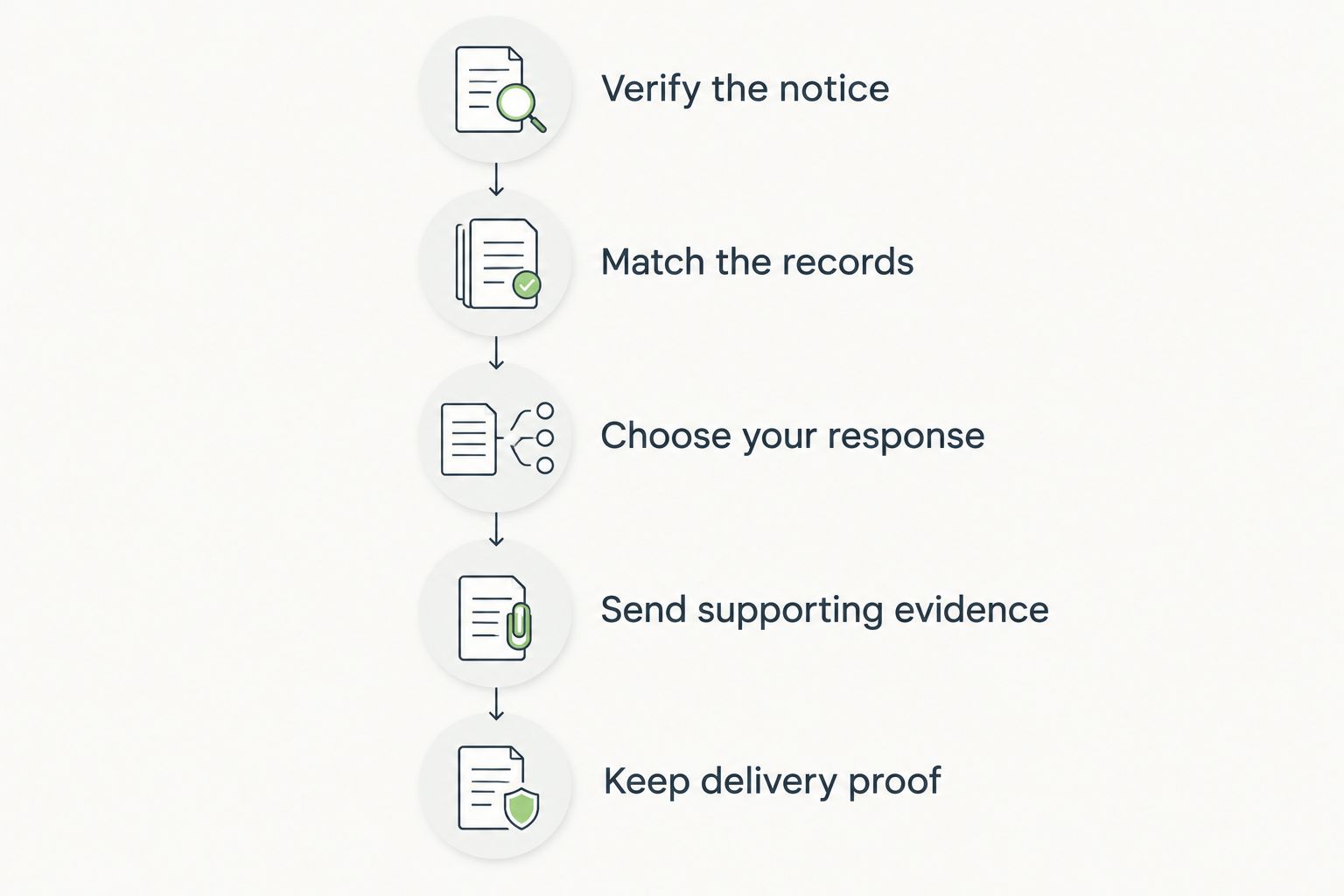
1. Verify the notice
Check your name, taxpayer identification details, tax year, notice date, and response deadline. Compare the letter with your own records before sending personal information or payment.
If you question its authenticity, verify the contact information through an independently accessed IRS channel. Do not rely on an unsolicited message demanding payment as proof that a CP2000 is genuine.
2. Match the records
Gather the return you actually filed, the schedules supporting it, the CP2000, and the relevant payer statements. A draft return is not a substitute for the filed version.
Create a simple reconciliation for each disputed item: what the payer reported, where it appears on your return, and why the amounts or treatment differ. This turns a general disagreement into an explanation the IRS can evaluate.
3. Choose your response
Decide whether you agree with all, some, or none of the proposed changes. Read the response form before signing because your signature can communicate agreement with the adjustment.
If you disagree, identify each disputed item and attach copies of supporting records. Keep original documents unless the IRS specifically requires them.
4. Send supporting evidence
Use the submission method and destination printed on the notice. Include the requested response form and identifying information so the IRS can connect the documents to your case.
Keep your explanation focused. A document showing that income was already reported is more useful than a general statement that your return was prepared carefully.
5. Keep delivery proof
Save a complete copy of the response and evidence that you submitted it. Retain mailing records, fax confirmation, or the confirmation from an authorized electronic submission method, as applicable.
Do not treat sending a response as proof that the IRS has accepted your position. Read subsequent correspondence and check whether it addresses every disputed adjustment.
Should you agree, disagree, or ask for more time?
Agree only after you verify the proposed changes. The strongest response is the one supported by your records, not necessarily the shortest response or the one that produces the smallest balance.
| Response | Best for | Benefit | Limitation |
|---|---|---|---|
| Agree | A proposal you have checked and found correct | Communicates acceptance of the verified adjustment | Does not establish that you can afford payment |
| Disagree fully or partly | Incorrect, duplicated, already-reported, or incomplete information | Gives the IRS a basis to revise its proposal | Requires a clear explanation and supporting evidence |
| Request more time | Missing records or a response that cannot be completed by the deadline | Allows you to ask for time to prepare an accurate response | An extension is not automatic; confirm the IRS response |
| Seek professional help | Disputed tax treatment or records you cannot reconcile | Adds assistance with evaluating the discrepancy | You still need to provide records and monitor deadlines |
Contact the IRS using the notice instructions if you need more time. Make the request before the response deadline and document what the IRS tells you; do not assume that requesting an extension grants one.
Why CP2000 discrepancies vary
The notice identifies a mismatch, but the reason behind that mismatch determines the response. These factors change what evidence you need:
- Already-reported income: Identify the exact line or schedule where you included the amount. A different reporting location can require explanation rather than additional tax.
- Incorrect payer reporting: Contact the payer about a correction and explain the error to the IRS. Do not let the correction request replace a timely notice response.
- Investment cost basis: Gross sale proceeds alone do not establish taxable gain. Records supporting basis can change the proposed result.
- Business receipts and expenses: Reconcile reported payments with business records, then document relevant expenses separately. A payment statement alone does not establish net profit.
- Withholding differences: Compare withholding on your return with the payer documents. A discrepancy can involve tax already paid, not only income.
- Ownership or identity errors: Explain income that belongs to someone else or involves identity theft using the appropriate IRS instructions and evidence.
Do not send an unrelated archive of receipts. Connect each attachment to a specific proposed change so the IRS can follow your explanation without reconstructing your entire return.
Does a CP2000 notice mean you owe the amount shown?
No. A CP2000 shows a proposed adjustment, and the amount can change after the IRS reviews your explanation and documents. Check the proposed tax, penalties, interest, and withholding adjustments rather than reviewing only the final total.
For example, investment proceeds and investment profit are not interchangeable. If the proposal does not reflect supported cost basis, your response should explain the basis and include the records establishing it—not simply state that the proposed tax feels excessive.
Do you need to file an amended return for a CP2000?
Generally, you do not need to file an amended return solely to address the changes proposed in a CP2000. Follow the notice's response instructions; an amended return is not a substitute for answering the letter.
Separate errors can require different treatment. If reviewing the notice uncovers an unrelated mistake, address how to correct that mistake without leaving the CP2000 response unanswered.
What happens if you ignore a CP2000 notice?
Ignoring a CP2000 can lead the IRS to issue a statutory notice of deficiency proposing additional tax. That later notice carries a separate deadline for petitioning the U.S. Tax Court.
The general Tax Court petition period is 90 days from mailing of the deficiency notice. It is generally 150 days when the notice is addressed to a person outside the United States; use the specific notice and applicable rules rather than treating either period as extra time to answer a CP2000.
For 2026 correspondence, keep the CP2000 response date and any later petition deadline separate. Requesting IRS review or sending more documents does not extend the statutory Tax Court petition period.
When should you get tax resolution help?
Professional help is most useful when you cannot reconcile the proposed income, the notice involves disputed tax treatment, or later correspondence creates additional procedural deadlines. Bring the filed return and the full notice, not just the page showing a proposed balance.
Rutter Organization is best suited to individuals and businesses seeking tax resolution services. The organization serves those audiences, but the facts of your notice determine the assistance you need.
When evaluating Rutter Organization or another provider, ask who will review the discrepancy, who will prepare the response, and whether representation is included. Confirm the scope before engaging a provider; tax preparation, notice-response assistance, and representation are not interchangeable services.
You remain responsible for supplying complete records and tracking correspondence. Professional assistance does not make an incorrect payer statement accurate or remove the need to meet a deadline.
FAQ
Does a CP2000 notice mean I'm being audited?
No. A CP2000 proposes changes after the IRS identifies differences between your return and information reported by payers. The IRS does not classify the notice itself as an audit.
How long do I have to respond to a CP2000 notice?
The IRS generally allows 30 days to respond, but use the response date printed on your CP2000. Request additional time before that date if you cannot complete your response.
Should I pay a CP2000 notice immediately?
Verify the proposed changes before agreeing or paying. A CP2000 is not a final bill, and your records can support a different result.
Can I disagree with only part of a CP2000?
Yes. Identify the proposed changes you accept and explain each disputed item with supporting documents. Follow the instructions on your response form.
What if the income on my CP2000 was already reported?
Show the IRS exactly where you reported the income on your filed return. Include the relevant schedule and records connecting that entry to the payer information.
Do I need an amended return to answer a CP2000?
Generally, no. Respond directly to the CP2000 using its instructions rather than filing an amended return as a substitute for answering the notice.
Can Rutter Organization help with tax resolution?
Rutter Organization provides tax resolution services to individuals and businesses. Confirm the scope of assistance for your specific notice before engaging services.
One last thing
The decisive question is not whether the IRS received a payment report—it is whether your return treated that payment correctly. A reported amount can be accurate while the proposed tax adjustment is wrong because relevant information is missing.
For your 2026 response, make the evidence easy to follow: identify the disputed item, explain its treatment, and attach the record that supports your position. Keep the complete response and delivery confirmation together until the issue is resolved.


