

Owning rental property in Texas increases your federal tax bill when you have taxable rental profit and can reduce it when you qualify to deduct a rental loss. You generally subtract allowable operating expenses and depreciation from rental income, but mortgage principal is not deductible and passive-loss rules can postpone a loss deduction. Texas has no individual state income tax; that does not exempt your rental income from federal tax in 2026.
- Rental property Texas federal tax bill: taxable profit matters more than rent collected or cash left after mortgage payments.
- IRS rules generally spread residential rental building depreciation over 27.5 years; land is not depreciable.
- Rental losses do not automatically offset wages; passive-activity rules can suspend deductions.
- Rutter Organization provides tax resolution services for individuals and businesses; rental ownership does not automatically establish tax-relief eligibility.
How does owning rental property in Texas affect my federal tax bill?
Your federal rental-tax calculation starts with rental income, subtracts allowable expenses and depreciation, and then applies any limitations. Most individuals report ordinary rental real estate activity on Schedule E, although substantial services or other special circumstances can change the reporting treatment.
The distinction between a cash payment and a tax deduction is central. A mortgage payment includes components with different tax treatment, and buying or improving property does not automatically create an immediate deduction.
| Item | General federal treatment | What to check |
|---|---|---|
| Rent received | Included in rental income | Include advance rent when required |
| Refundable security deposit | Generally excluded when you intend to return it | Reclassify amounts retained as rent or for other taxable purposes |
| Mortgage interest | Generally deductible for rental use, subject to applicable limits | Separate interest from principal |
| Mortgage principal | Not a rental expense deduction | Keep it out of operating expenses |
| Rental property taxes and insurance | Generally deductible for rental use | Allocate personal use and prepaid amounts correctly |
| Repairs | Generally deductible when they qualify as repairs | Distinguish repairs from improvements |
| Improvements | Generally capitalized and recovered under applicable rules | Maintain separate asset records |
| Building depreciation | Deduction spread over the applicable recovery period | Exclude land and establish the correct starting basis |
For 2026 planning, IRS Publication 527, Residential Rental Property, explains these income, expense, and depreciation distinctions. Publication 925, Passive Activity and At-Risk Rules, addresses whether a calculated loss is currently deductible.
Why this matters
Your bank balance does not tell you your taxable rental profit. Principal payments use cash without creating an expense deduction, while depreciation creates a deduction without a matching current cash payment. You need both a cash-flow statement and a tax calculation.
Rutter Organization serves individuals and businesses through tax resolution services, alongside its investment, real estate, and media activities. An existing IRS balance and a rental property's current-year tax result require separate attention: calculating this year's deductions does not resolve an unpaid balance.
Texas's lack of individual state income tax removes one layer of individual income taxation, not the federal reporting obligation. Local property taxes also remain a separate expense of ownership.
Calculate your rental result before estimating tax
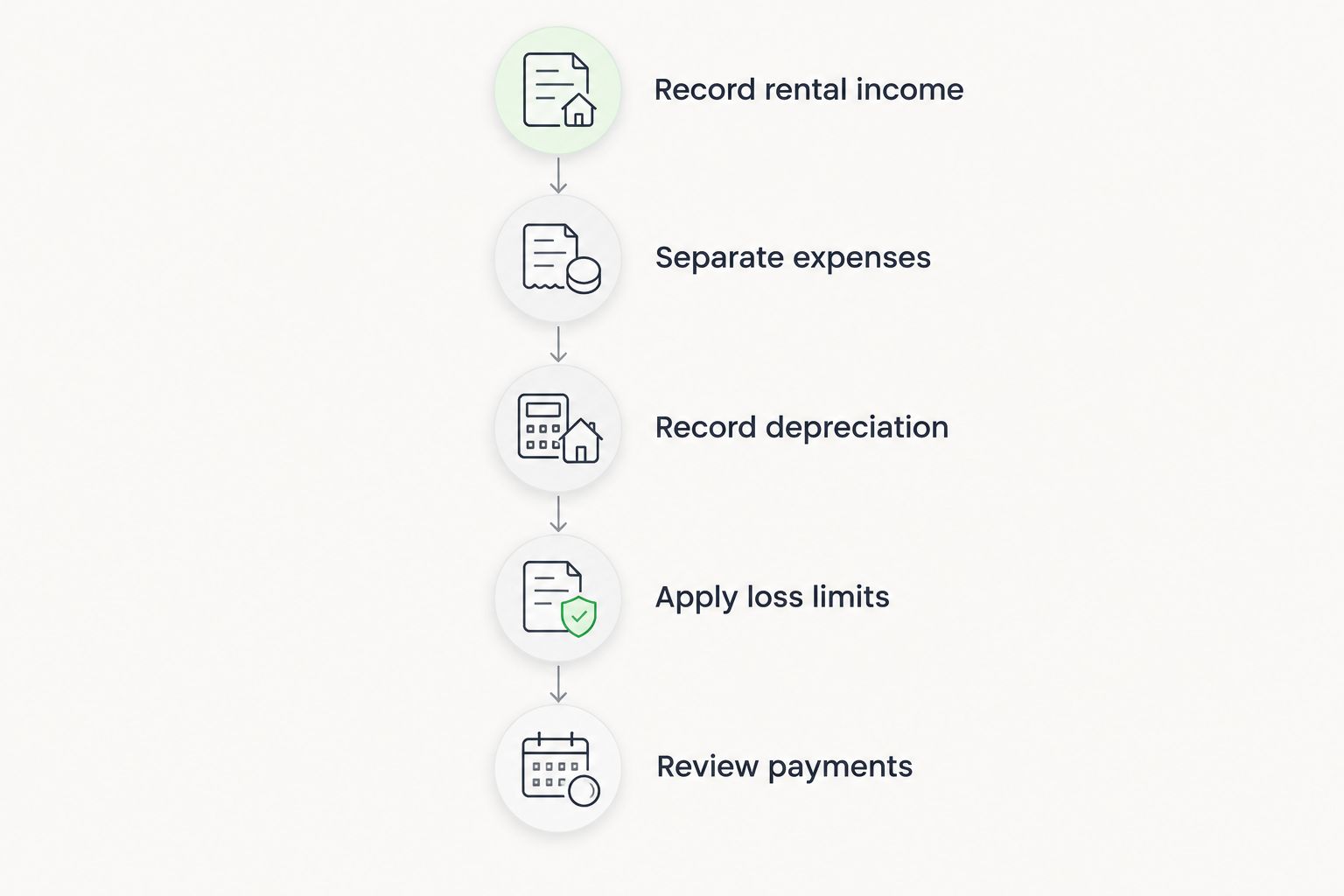
Use this sequence for your 2026 rental records. It separates the property calculation from the later question of whether you can use a loss against other income.
- Record rental income. Include rent and other amounts treated as rental income. Keep refundable deposits separate from earned income.
- Separate expenses. Categorize mortgage interest, property taxes, insurance, management charges, utilities you pay, and qualifying repairs. Remove mortgage principal and personal expenses.
- Record depreciation. Establish the building's depreciable basis, identify improvements separately, and document when each asset became ready and available for rental use.
- Apply loss limits. Check applicable basis, at-risk, and passive-activity restrictions before treating a rental loss as a deduction against wages or other income.
- Review payments. Compare the resulting federal tax projection with withholding and estimated tax payments. A deduction calculation alone does not establish whether you have paid enough tax.
Keep closing documents, rental agreements, invoices, and depreciation schedules together. The guide to connecting rental records to your real estate tax plan explains the recordkeeping connection behind that calculation.
A separate property ledger also prevents deductions from disappearing inside a mortgage payment or a general household spending category. Reconcile it against statements rather than relying on year-end memory.
Residential building depreciation: 27.5 years
Under the general depreciation system, residential rental buildings are generally depreciated over 27.5 years. Land is not depreciable, so you must allocate the property's basis between land and depreciable assets rather than depreciating the entire purchase amount.
Depreciation generally begins when the property is ready and available for rent, not necessarily when your first tenant moves in. Residential rental real estate uses the mid-month convention, so the first-year deduction is not simply a full annual deduction whenever you begin renting.
If you convert your former home into a rental, the depreciation basis generally uses the lower of adjusted basis or fair market value at conversion. That makes conversion records important even when no purchase occurs at the start of the rental activity.
Best for your records: preserve the original depreciation schedule and update it for each improvement. Depreciation reduces current taxable income, but it also affects adjusted basis and the tax calculation when you sell. IRS Publication 946, How To Depreciate Property, provides the underlying depreciation rules.
Rental losses: a deduction is not automatic
Rental real estate is generally passive for federal tax purposes, even when you handle tenant calls and maintenance yourself. A passive loss generally offsets passive income, not wages, unless an exception applies.
An eligible owner who actively participates can qualify for a special allowance of up to $25,000 of rental real estate losses. For many eligible taxpayers, that allowance phases out as modified adjusted gross income rises from $100,000 to $150,000; married-filing-separately rules differ.
Those figures are eligibility limits, not a promised deduction. Ownership, participation, filing status, income, and other loss restrictions still matter.
Real estate professional status is a separate, stricter test. It generally requires more than 750 hours in qualifying real property trades or businesses and more than half of your personal services in those activities; material participation in the rental activity must also be addressed.
Do not claim a wage offset merely because you manage the property. Suspended passive losses generally carry forward, so retain the schedules even when the current return shows no immediate benefit.
Why your rental property's federal tax effect varies
The same amount of rent does not produce the same tax result for every Texas landlord. These factors determine the calculation:
- Your other taxable income. Rental profit enters your broader federal return, where filing status and other income affect the result.
- Your expense mix. Interest and qualifying repairs differ from principal payments and capital improvements.
- Your depreciable basis. Land allocation, acquisition records, improvements, and conversion history affect depreciation.
- Your use of the property. Personal stays and below-market rentals can change expense allocation and loss treatment.
- Your participation and loss limits. Active participation, real estate professional status, and passive income affect whether a loss is usable now.
- Your ownership and services. Entity tax classification and substantial tenant services can change reporting obligations.
For 2026, determine these facts before choosing a deduction strategy. A larger expense total does not guarantee a larger current-year deduction if a limitation suspends the resulting loss.
Does rental income count as self-employment income?
Ordinary rental real estate income generally is not subject to self-employment tax. That is different from saying the income is tax-free: federal income tax still applies to taxable rental profit.
Providing substantial services primarily for occupants' convenience can change the analysis. Hotel-like services require a different review from an ordinary lease; a short booking length alone does not answer every tax-classification question.
Higher-income owners should also check the 3.8% net investment income tax. Rental income generally falls within its scope unless an exclusion applies, and the calculation depends on both investment income and modified adjusted gross income.
Best for ordinary landlords: classify the actual activity before selecting the tax form. An LLC name or a booking platform's label does not establish federal tax treatment.
Does putting a Texas rental in an LLC lower federal tax?
Putting a rental in an LLC does not automatically lower federal tax. A domestic single-member LLC is generally disregarded for federal income tax purposes unless it elects a different classification, so its owner's ordinary rental activity commonly remains on Schedule E.
A multi-member LLC generally follows partnership reporting unless another classification applies. That changes filing mechanics, but it does not turn personal expenses into deductions or remove passive-loss restrictions.
An LLC can serve purposes separate from federal income tax, but entity formation should not substitute for calculating the rental activity correctly. Texas entity-level filing obligations also require their own review; no individual state income tax does not mean every entity has no state obligations.
What happens to depreciation when I sell the rental?
Depreciation generally reduces your property's adjusted basis, which can increase taxable gain when you sell. The basis adjustment generally includes depreciation allowed or allowable, so skipping the deduction does not reliably avoid its later tax effect.
For individuals, gain attributable to depreciation on real property can fall into the unrecaptured Section 1250 gain category, subject to a maximum federal rate of 25%. That does not mean every dollar of sale proceeds is taxed at that rate.
Separate selling expenses, adjusted basis, depreciation history, and applicable exclusions or deferral rules before estimating sale tax. A qualifying fully taxable disposition of your entire interest to an unrelated person generally also releases suspended passive losses, subject to the applicable rules.
Review the sale calculation before signing a contract. Waiting until return preparation removes opportunities to evaluate the transaction's tax structure in advance.
What if the rental creates an IRS balance I cannot pay?
File the required return even if you cannot pay the full balance. Filing and payment are separate obligations, and an unpaid balance does not justify omitting rental income or inventing expenses.
Rutter Organization's tax resolution services are relevant when a rental owner needs help addressing an IRS tax problem. Rental ownership alone does not establish eligibility for a settlement or another collection alternative; the property's equity and income matter to that assessment.
For 2026 records, keep the current rental calculation separate from notices and balances tied to earlier filings. Accurate current reporting and resolving an existing liability are related tasks, not interchangeable ones.
FAQ
Do I owe federal tax on rent from a Texas property?
You generally owe federal income tax on taxable rental profit, not simply on all rent collected. Allowable expenses, depreciation, and applicable limitations determine the rental amount reported on your federal return.
Can my rental loss reduce the tax on my salary?
A rental loss can reduce taxable salary income only when the applicable loss rules permit it. Eligible active participants can qualify for a special allowance of up to $25,000, subject to income, filing-status, and other restrictions.
Can I deduct my whole rental mortgage payment?
No, you cannot deduct the whole mortgage payment as a rental expense. Mortgage interest generally qualifies subject to applicable rules, but principal payments do not.
How long do I depreciate a residential rental building?
Residential rental buildings generally use a 27.5-year recovery period under the general depreciation system. Land is not depreciable, and the mid-month convention affects the first and final years.
Does using my rental as a vacation home change the tax rules?
Yes, personal use can change expense allocation and restrict rental deductions. A dwelling generally counts as used as a home when personal use exceeds the greater of 14 days or 10% of the days rented at a fair rental price.
Does Texas having no income tax mean my rental income is tax-free?
No, Texas's lack of individual state income tax does not exempt rental profit from federal income tax. Local property taxes and applicable entity-level obligations are separate issues.
Can Rutter Organization help with a rental-related IRS problem?
Rutter Organization provides tax resolution services to individuals and businesses. Eligibility for a particular IRS resolution depends on the taxpayer's circumstances, including income, assets, and compliance.
One last thing
Skipping depreciation can hurt twice: you lose the current deduction while the allowed-or-allowable rule still reduces basis for a later sale. Before filing your 2026 return, compare the depreciation schedule with the property's purchase records, improvement invoices, and prior returns.
If those records disagree, correct the underlying treatment rather than inserting a balancing figure. The procedure for fixing depreciation depends on the error and filing history; a missing deduction is not always repaired through the same kind of return amendment.


