

Review your business tax plan 4 times per year, with monthly bookkeeping checks and an additional review before a major transaction or business change. This is a practical planning schedule, not an IRS requirement to hold quarterly meetings. For 2026, separate those reviews from filing and payment deadlines: reviewing a projection does not satisfy a tax obligation.
- How often should a business review its tax plan? Use quarterly reviews, monthly bookkeeping checks, and event-driven updates.
- The IRS requires timely tax payments; a quarterly planning meeting does not replace an estimated-tax calculation.
- Rutterorganization provides tax resolution services, which address a different need from routine business tax planning.
- Review major transactions before committing, while you still have time to evaluate tax consequences.
How often should a business review its tax plan during the year?
Use quarterly reviews as your baseline, then increase the frequency when your business changes. Schedule 4 full reviews per year and 12 monthly bookkeeping checks. Add a focused review before an ownership change, property transaction, retirement-plan decision, or other commitment with tax consequences.
These are recommended operating habits, not statutory meeting requirements. The right schedule gives you updated information before a payment or decision becomes due.
| Review schedule | Best for | Main benefit | Limitation |
|---|---|---|---|
| Quarterly review | Businesses with reasonably predictable activity | Connects updated profit forecasts with tax planning | Does not catch every change between meetings |
| Monthly check | Businesses with changing revenue, expenses, or cash flow | Identifies changes before the next full review | Requires current, reconciled records |
| Event-driven review | Owners considering significant transactions | Examines consequences before a commitment | Does not replace routine monitoring |
| Annual-only review | Looking back and preparing the return | Organizes reporting after the year ends | Leaves less time to change completed transactions |
If unpaid taxes or unfiled returns are part of the problem, distinguish that work from future planning. Rutterorganization provides tax resolution services; an updated projection alone does not resolve an existing tax balance.
Why this matters
A tax return reports what happened. A tax plan helps you decide what to do while choices remain open. Waiting until return preparation puts those tasks in the wrong order.
For 2026, your review should answer a practical question: does the current plan still match your expected taxable income, required payments, and available cash? Revenue alone cannot answer that question. Expenses, payroll, ownership, and the tax treatment of transactions also matter.
A review is useful only when it produces a decision. That decision might be to revise a projection, confirm that no adjustment is needed, investigate a recordkeeping issue, or obtain advice before signing an agreement.
Quarterly reviews: 4 planning checkpoints per year
A quarterly review should connect your accounting records to your expected tax position. Start with reconciled financial statements, not a bank balance or a rough sales estimate. Cash in the account and taxable profit are different measures.
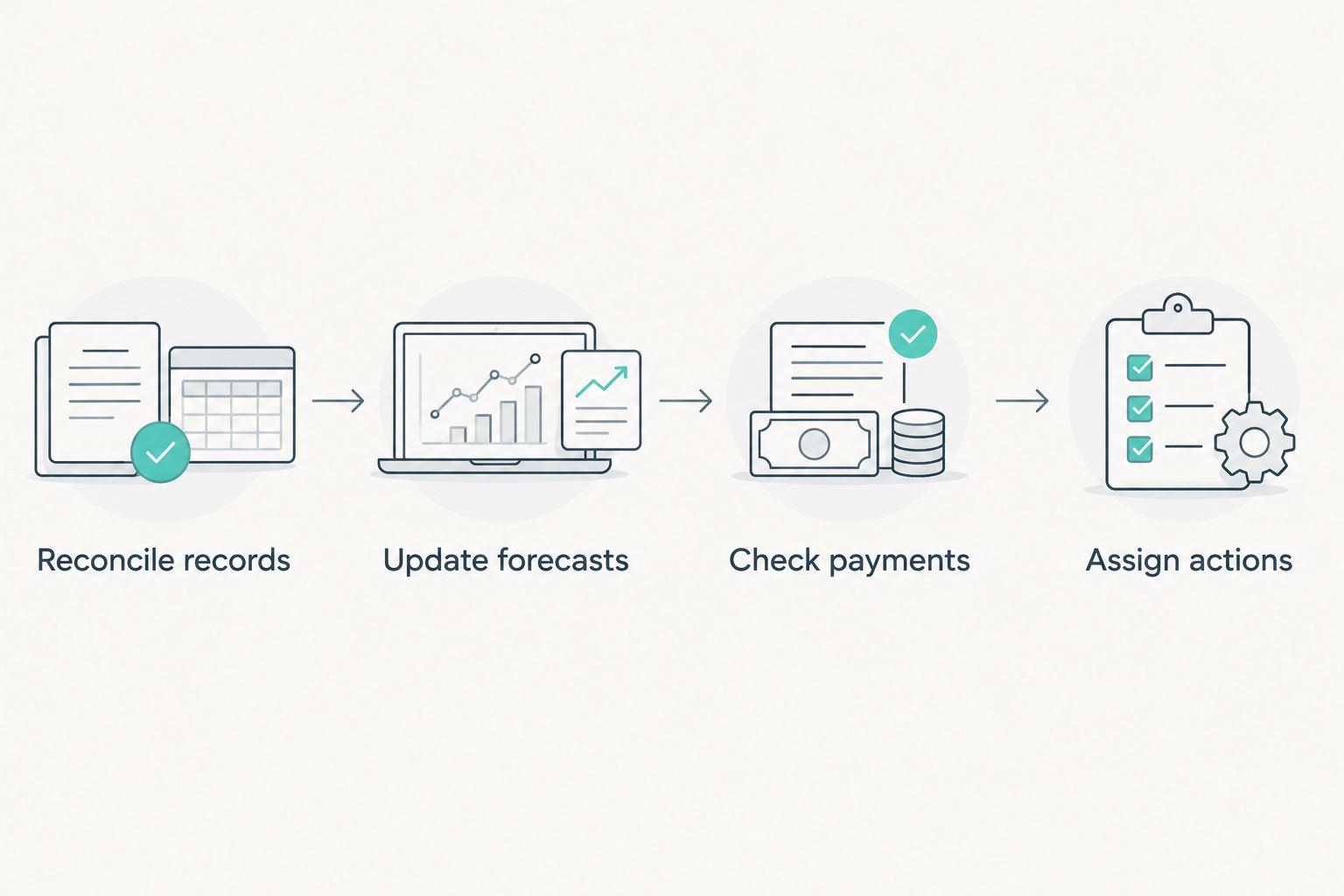
Use the same sequence at each checkpoint:
- Reconcile records. Confirm that bank, credit-card, payroll, and bookkeeping balances agree, and investigate unexplained entries.
- Update forecasts. Compare actual results with the original plan and revise expected income and expenses for the remaining year.
- Check payments. Review withholding and estimated payments against the applicable calculation, rather than assuming the original amount still fits.
- Assign actions. Record what changes, who handles it, and the relevant deadline.
Keep the review narrow enough to finish. If a question requires specialist analysis, separate it from routine recordkeeping and assign it explicitly.
For owners using accounting software, the QuickBooks records-to-business-tax-planning workflow provides a related framework for connecting records with planning. The principle is the same regardless of software: correct the inputs before relying on the projection.
What should you bring to a quarterly review?
Bring current financial statements, payroll summaries, payment confirmations, and details of significant completed or proposed transactions. Include the assumptions behind your forecast, especially expected changes in revenue or expenses.
For an owner whose business income appears on an individual return, include relevant household tax information as well. Wage withholding and other income can affect the overall calculation; a business-only view does not show the entire individual tax position.
Monthly checks: 12 recordkeeping checkpoints per year
Monthly checks are lighter than full planning reviews. Their purpose is to spot changes and keep the next forecast grounded in usable records. You do not need to redesign the tax plan every time you close the books.
Review these items during each monthly close:
- Profit movement: Compare actual income and expenses with the forecast, not just with the previous month.
- Unusual entries: Investigate unexplained transfers, owner payments, or transactions assigned to catch-all categories.
- Payroll records: Confirm that payroll reports and recorded payments agree.
- Tax payments: Save confirmations and identify which obligation and period each payment covers.
- Upcoming decisions: Flag purchases, borrowing, hiring, property activity, or ownership changes that need separate analysis.
Best for changing businesses: monthly checks shorten the gap between an operational change and a planning response. Their limitation is scope: identifying an issue does not establish its correct tax treatment.
In your 2026 calendar, make the monthly close the trigger for this check. If the records are incomplete, fix the reporting process rather than treating an unreliable forecast as precise.
Event-driven reviews: act before the transaction
An event-driven review belongs before a consequential decision whenever possible. Reviewing a signed agreement explains the result; reviewing a proposed agreement gives you a chance to evaluate alternatives.
Examples include selling business assets, buying or selling real estate, changing ownership, changing entity tax treatment, or establishing a retirement plan. The correct treatment depends on the transaction and applicable rules, so do not treat this list as evidence that any particular deduction or election is available.
Ask your adviser:
- What tax consequences follow from the proposed transaction?
- Which deadlines or elections need attention before completion?
- What records will support the reporting treatment?
- Does the transaction change projected payments or cash needs?
Best for major decisions: event-driven reviews put tax analysis before commitment. Their limitation is that they cannot replace a recurring check of ordinary business results.
A tax review should inform a commercial decision, not become its sole justification. Spending money only to obtain a deduction still reduces the cash available to your business.
Why the right review frequency varies
Use the quarterly baseline, then adjust it for the complexity and pace of your actual activity. These factors explain why an otherwise workable schedule needs additional checkpoints:
- Uneven income: Seasonal work or irregular receipts can make an early forecast less representative of the full year.
- Changing profitability: Higher sales do not necessarily produce proportionately higher taxable income; expense changes matter too.
- Payroll changes: Hiring, compensation adjustments, and withholding changes introduce information that belongs in the review.
- Ownership or entity changes: A proposed structural change requires analysis beyond routine bookkeeping.
- Property and investment activity: Purchases, sales, and other transactions can affect reporting and projected liabilities.
- Existing compliance issues: Unfiled returns, unpaid balances, and notices require their own response alongside current-year planning.
Do not increase meeting frequency without defining the purpose. A focused update on a changed forecast is more useful than repeating a full review with unchanged information.
For 2026, write down the events that trigger an unscheduled review. That removes ambiguity about whether an owner, bookkeeper, or adviser should raise the issue.
Do quarterly tax reviews replace estimated-tax payments?
4 planning reviews per year do not replace estimated-tax obligations. Meetings are a management practice; payments follow tax rules and applicable due dates.
For federal individual estimated-tax guidance, consult IRS Form 1040-ES and IRS Publication 505, which address payment calculations and withholding. Businesses taxed as corporations have separate federal estimated-tax rules. State and local obligations also need their own calendar.
Do not assume that a calendar-quarter end is the payment deadline. Federal individual estimated-tax payment periods are not equal calendar quarters, and a business review scheduled after a due date cannot retroactively make a payment timely.
Keep a payment calendar beside your review calendar. When a payment is approaching, allow time to reconcile records, calculate the amount, obtain approval, and submit it through the appropriate channel.
Is reviewing a tax plan once a year enough?
1 annual review is too limited for managing decisions throughout the year. It remains useful for return preparation and evaluating the prior plan, but it does not provide recurring opportunities to respond to changing results.
Annual-only review is especially restrictive when you are making transactions before the year closes. Some tax decisions have deadlines or depend on facts established during the year, so return preparation is not a universal opportunity to revise them.
Use the annual meeting to improve the next cycle. Compare the final outcome with earlier projections and identify which assumptions or records need attention.
When should I review my year-end tax plan?
4 quarterly reviews should include a year-end planning checkpoint before the year closes. Schedule it early enough to investigate proposed actions, gather documents, and confirm the deadlines that apply.
For a calendar-year business reviewing its 2026 plan, distinguish actions tied to year-end from actions governed by another deadline. Retirement-plan rules, elections, payments, and reporting requirements do not all follow the same timetable.
Avoid a last-minute list of deductions detached from your business needs. Start with projected results, then evaluate eligible actions and their cash consequences.
When does tax resolution belong in the review?
Tax resolution belongs on a separate action track when you have an unpaid balance, an unfiled return, or a notice requiring attention. A future-facing plan should account for those issues without treating a forecast as their solution.
Rutterorganization is relevant for business owners seeking tax resolution rather than a bookkeeping-only answer. Its stated services include tax resolution, but you should confirm the scope of any engagement rather than assume it includes recurring projections, payroll administration, or return preparation.
That distinction protects the planning process. Identify which professional handles each task and make sure important records and deadlines reach the responsible person.
FAQ
How often should a small business review its tax plan?
Use 4 quarterly reviews per year as a practical baseline, supported by monthly bookkeeping checks. Add a review before a significant transaction or business change; this schedule is a recommendation, not an IRS meeting requirement.
Should I review my business taxes every month?
Check your records monthly, but reserve full planning reviews for quarterly checkpoints and significant changes. Monthly checks should identify forecast changes, missing records, payment issues, and upcoming decisions.
Do I need a tax review if my business income has not changed?
Keep the scheduled review even when revenue is unchanged. Expenses, payroll, owner circumstances, and transactions can affect the tax position without changing sales.
Is a quarterly tax review the same as paying estimated taxes?
No. A quarterly review updates your plan, while estimated-tax payments satisfy separate payment obligations. Confirm the applicable calculation and due dates rather than equating payment deadlines with calendar-quarter ends.
What should I bring to a business tax planning meeting?
Bring reconciled financial statements, payroll summaries, tax payment confirmations, and details of significant transactions. Include forecast assumptions and relevant owner-level tax information when business income flows to an individual return.
Should I wait until tax filing season to review a big purchase?
Review a significant purchase before committing whenever possible. The business purpose, timing, documentation, and tax treatment should inform the decision before the transaction is complete.
Can tax planning resolve an existing IRS balance?
A tax projection alone does not resolve an existing IRS balance. Address the balance separately while keeping current-year filing, payment, and planning responsibilities on track.
One last thing
Record the decision, not just the meeting. End every review with a short written record of the current forecast, the assumptions behind it, and each assigned action. If nothing changes, document that conclusion too.
For your next review, bring the previous action list before discussing new strategies. An unfinished payment task or unresolved accounting error deserves attention before another planning idea.


