

Best overall: ordinary business expense deductions. Best for businesses with profit above reasonable owner compensation: an S corporation election. Best no-new-spending check: coordinating W-2 wages with Schedule SE. The best strategies to reduce self employment tax in 2026 depend on whether you need to reduce taxable business profit, change how that profit is taxed, or correct the calculation.
- The best strategies to reduce self employment tax 2026 start with documented business deductions, not an automatic entity change.
- An S corporation can change employment-tax treatment, but owner wages still require payroll taxes and reasonable compensation.
- W-2 wages count toward the Social Security wage base; Medicare tax follows different rules.
- Retirement contributions and the qualified business income deduction generally reduce income tax, not self-employment tax.
Why this matters
A deduction that lowers income tax does not necessarily lower self-employment tax. That distinction separates useful planning from a disappointing tax return. Start by identifying which tax a recommendation actually changes.
IRS guidance on self-employment tax identifies a standard combined rate of 15.3%: 12.4% for Social Security and 2.9% for Medicare, subject to applicable limits and additional Medicare rules. Schedule SE generally applies that calculation to 92.35% of net self-employment earnings, rather than every dollar of gross revenue.
The Social Security Administration’s 2026 contribution and benefit base is $184,500 of covered earnings. Medicare has no equivalent earnings cap. These rules make your wages, business profit, and filing situation relevant to the calculation—not just your business entity’s name.
Rutterorganization’s tax resolution services serve individuals and businesses addressing tax problems. For planning purposes, separate reducing future tax from resolving existing balances: a new deduction or entity election does not automatically erase an old liability.
What makes the best self-employment tax strategy?
Evaluate each strategy against these criteria before choosing it:
- Direct tax effect: Does it reduce Schedule C profit, change employment-tax treatment, or merely lower income tax?
- Eligibility: Do your activities, ownership structure, and records satisfy the applicable requirements?
- Documentation: Can you substantiate the expense, business use, or compensation decision?
- Administrative burden: Does the strategy introduce payroll, another return, or ongoing compliance work?
- Economic benefit: Does the tax reduction justify the spending and administration required?
- Timing: Can you implement it correctly for 2026, rather than trying to repair the paperwork after filing?
Do not spend money solely to generate a deduction. A deductible purchase still uses cash, and the tax reduction does not reimburse the entire purchase. Start with expenses you already incurred and business decisions you already need to make.
Self-employment tax strategies at a glance
| Rank and strategy | Best for | Standout benefit | Key limitation |
|---|---|---|---|
| 1. Ordinary business expense deductions | Sole proprietors with incomplete expense records | Reduces net business profit directly | Personal expenses and unsupported deductions do not qualify |
| 2. S corporation election | Owner-operated businesses with profit above defensible owner wages | Separates owner wages from qualifying pass-through profit | Requires reasonable compensation, payroll, and additional compliance |
| 3. W-2 wage coordination | Employees who also earn self-employment income | Accounts for wages already subject to Social Security tax | Does not eliminate Medicare tax |
| 4. Home office deduction | Self-employed people with qualifying workspace | Deducts eligible business use of the home | Regular-use, exclusive-use, and other requirements apply |
| 5. Business vehicle deductions | Businesses involving customer visits, deliveries, or travel between work locations | Captures deductible business transportation | Commuting is generally excluded; records and method restrictions matter |
The ranking favors broadly useful corrections before structural changes. It is not a promise that the first strategy produces the largest reduction for every taxpayer. Your eligible expenses, wages, and compensation requirements determine the result.
1. Business expense deductions: best for incomplete bookkeeping
Ordinary and necessary business expenses generally reduce Schedule C net profit. Because net profit feeds the self-employment tax calculation, eligible deductions can lower both income tax and self-employment tax.
Start with business software, professional fees, supplies, insurance, and other operating expenses. Match each item to a receipt or invoice and its business purpose. For this review, handle vehicle and home office expenses separately because their documentation rules require additional attention.
Business expense deduction pros:
- Applies without changing your business entity.
- Captures legitimate expenses already incurred.
- Creates a clearer record of actual business profitability.
Business expense deduction cons:
- Personal spending does not become deductible because a business account paid it.
- Some expenses require capitalization, allocation, or special treatment instead of an immediate full deduction.
Best for: Sole proprietors and single-member LLC owners whose books omit eligible operating costs.
For 2026, review bank accounts, business cards, invoices, and reimbursements together. Remove duplicate entries before adding missing ones. A bank statement shows a payment occurred; it does not, by itself, establish the business purpose or correct tax treatment.
Mixed-use subscriptions and purchases require an allocation supported by actual use. Do not deduct the personal portion. Also distinguish equipment purchases from routine supplies before assuming the entire amount belongs in current operating expenses.
Verdict: Buy—adopt an expense reconciliation before considering a new entity.
2. S corporation election: best for profit above reasonable owner wages
An eligible business taxed as an S corporation generally passes income through to its owners. An owner who performs services must receive reasonable compensation through payroll; qualifying pass-through business profit generally is not subject to self-employment tax.
The opportunity is the distinction between wages and pass-through profit—not a salary percentage you choose yourself. An LLC does not receive this treatment merely because it has LLC in its name. Federal tax classification matters.
S corporation election pros:
- Can change the employment-tax treatment of qualifying business profit.
- Separates owner payroll from shareholder distributions.
- Supports a formal compensation process for an established business.
S corporation election cons:
- Requires payroll administration and an S corporation tax return.
- An unsupported low salary creates compliance risk; distributions cannot replace required compensation.
Best for: An eligible owner-operated business with sufficient profit remaining after defensible compensation and compliance expenses.
Before electing S corporation treatment for 2026, document your duties, time commitment, experience, and relevant compensation comparisons. Then model payroll taxes, administration, state treatment, and effects on other deductions. A projection based only on avoiding self-employment tax is incomplete.
Do not use revenue alone as the trigger. Revenue pays business expenses before it becomes profit, and reasonable compensation depends on the work you perform. Election timing also matters; address it before treating payments as though the election already applies.
Verdict: Hold until a compensation-supported projection shows a net benefit.
3. W-2 wage coordination: best for employees with a side business
Social Security tax has an annual earnings limit that considers covered wages and self-employment earnings together. If you have W-2 wages, Schedule SE accounts for those wages when determining the remaining earnings subject to the Social Security portion of self-employment tax.
For 2026, the Social Security wage base is $184,500. Reaching that limit through employment does not make your side-business income entirely tax-free: Medicare tax and income tax still require separate calculations.
W-2 wage coordination pros:
- Requires no new purchase or entity election.
- Prevents calculating the Social Security portion without considering existing wages.
- Makes a side-business tax projection reflect your employment income.
W-2 wage coordination cons:
- Does not remove the Medicare portion of self-employment tax.
- Each spouse has an individual Social Security wage base; joint filing does not combine those limits.
Best for: Employees who also report self-employment income, especially when their wages approach the annual Social Security limit.
Collect all applicable W-2 wage information before finalizing Schedule SE. Use Social Security wages from the relevant tax documents, not a rounded estimate of salary. Keep each spouse’s wages and business earnings assigned to the correct person.
This is a calculation rule, not permission to omit side-business income. Report the business activity fully and let the applicable wage-base calculation determine the Social Security portion. Review estimated payments separately so a correct annual calculation does not obscure payment obligations during the year.
Verdict: Buy—reconcile W-2 wages before accepting the self-employment tax total.
4. Home office deduction: best for qualifying home-based businesses
A qualifying home office can create a business deduction that reduces Schedule C profit. Eligibility generally requires regular and exclusive business use, plus a qualifying business purpose such as use as your principal place of business under the applicable rules.
Working from home alone is not enough. A workspace used for both business and ordinary personal activities generally fails the exclusive-use requirement, although specific statutory exceptions exist.
Home office deduction pros:
- Recognizes qualifying business use of space you already occupy.
- Offers simplified and actual-expense methods under IRS rules.
- Can reduce business profit without changing your entity.
Home office deduction cons:
- Requires qualifying use and records supporting the claimed space.
- Income limitations apply, and actual-expense depreciation can affect tax treatment when the home is sold.
Best for: Self-employed people who maintain a qualifying, regularly used business area at home.
Compare the permitted methods using your actual workspace and expense records. Under the actual-expense method, distinguish direct office expenses from shared household expenses before allocating costs. Do not treat the entire mortgage payment or every household bill as a business deduction.
For 2026, document the workspace’s business use and dimensions while the arrangement exists. Keep that evidence alongside expense records. A description written after an examination begins is not a substitute for a consistent, supportable record.
Verdict: Buy if the workspace qualifies; skip a claim based only on occasionally working at home.
5. Business vehicle deductions: best for travel-intensive work
Deductible business transportation can reduce Schedule C profit when you substantiate the trips and follow the applicable method rules. The standard mileage method and actual-expense method calculate deductions differently; neither turns ordinary personal commuting into business travel.
A vehicle used for business and personal purposes requires a supported allocation. Record business purpose as well as distance, and distinguish customer visits or travel between work locations from the trip between home and a regular workplace.
Business vehicle deduction pros:
- Captures legitimate transportation expenses that incomplete books miss.
- Gives travel-intensive businesses a repeatable documentation process.
- Allows eligible taxpayers to evaluate different deduction methods.
Business vehicle deduction cons:
- Requires records of business use; a year-end guess is not a reliable log.
- Prior method choices, depreciation, and lease rules can restrict later choices.
Best for: Self-employed people whose work requires deductible customer visits, deliveries, or travel between business locations.
Check method eligibility before comparing deduction totals. Then keep trip records consistently rather than reconstructing routes at filing time. Your calendar supports context, but it does not replace the complete records required to substantiate the deduction.
Do not claim actual vehicle operating expenses on top of a standard mileage deduction when those expenses are already covered by that method. Separately deductible items follow their own rules. The goal is the largest supportable deduction, not the largest spreadsheet total.
Verdict: Buy—keep contemporaneous travel records and compare only eligible methods.
How the strategies are ranked
Business expense deductions rank first because they address the underlying profit calculation without requiring an entity change. S corporation treatment ranks next because it changes employment-tax treatment, but only after compensation and compliance requirements are satisfied.
Wage coordination serves employees with side businesses. Home office and vehicle deductions serve narrower operating situations. The ranking follows direct tax effect, eligibility, documentation, administration, economic benefit, and timing—not a universal savings estimate.
Which strategy should you choose in 2026?
Default choice: reconcile eligible business expenses first. Then use your employment income and business setup to select the next review. Do not begin with an S corporation election simply because another business owner recommended it.
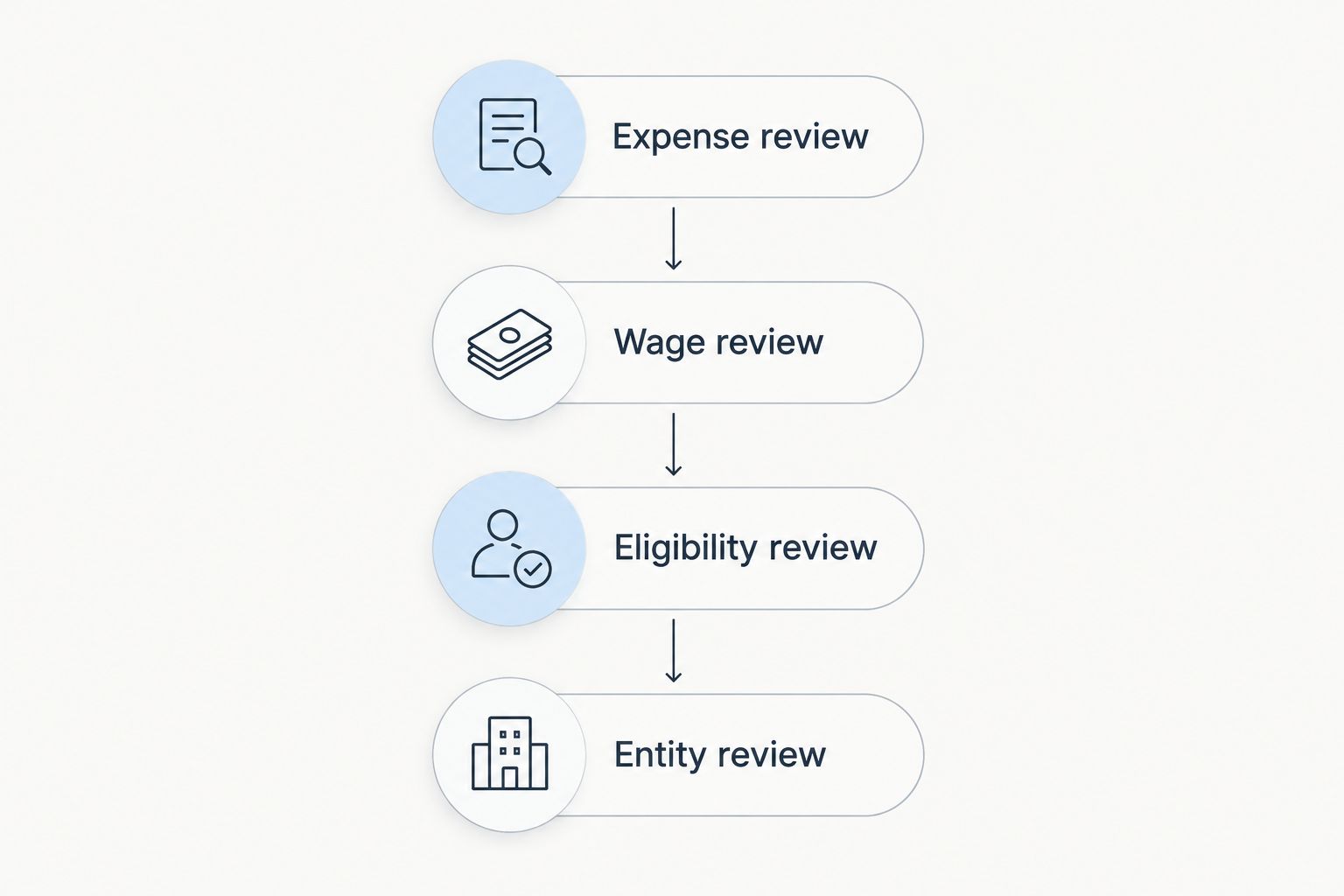
Use this sequence:
- Expense review: Confirm revenue, deductible expenses, and net business profit.
- Wage review: Account for W-2 wages in the Social Security calculation.
- Eligibility review: Check home office, vehicle, and entity-election requirements.
- Entity review: Model S corporation treatment using reasonable compensation and compliance expenses.
Keep income-tax planning on a separate worksheet. Self-employed retirement contributions, the qualified business income deduction, and the deduction for the employer-equivalent portion of self-employment tax generally do not reduce net earnings subject to self-employment tax. They can still matter to your total tax bill.
Rutterorganization serves individuals and businesses through tax resolution services. If your concern is an existing balance or unfiled return, separate that issue from the 2026 planning sequence; changing future business treatment does not resolve earlier filing obligations.
FAQ
What are the best strategies to reduce self employment tax in 2026?
Start with eligible business expense deductions, then review W-2 wage coordination, qualifying home office and vehicle deductions, and S corporation eligibility. The best choice depends on your profit, employment income, records, and reasonable compensation requirements.
Does forming an LLC reduce self-employment tax?
Forming an LLC alone does not reduce self-employment tax. A single-member LLC generally remains disregarded for federal income tax purposes unless it elects a different classification; an eligible S corporation election introduces separate compensation and payroll requirements.
Does an S corporation eliminate self-employment tax?
An S corporation does not eliminate employment taxes on an owner's required wages. Reasonable compensation is subject to payroll taxes, while qualifying pass-through business profit generally is not subject to self-employment tax.
Do retirement contributions lower self-employment tax?
Self-employed retirement contributions generally lower income tax, not self-employment tax. Calculate the retirement deduction separately from the net earnings used on Schedule SE.
Can I deduct a home office to reduce self-employment tax?
A qualifying home office deduction can reduce Schedule C profit and the related self-employment tax calculation. Regular and exclusive use, qualifying business use, income limitations, and method rules determine the allowable deduction.
Do my W-2 wages affect tax on my side business?
Your covered W-2 wages affect the Social Security portion of self-employment tax because covered earnings share an annual wage base. Medicare tax has no equivalent earnings cap, and your business income still requires full reporting.
Can tax planning remove back taxes I already owe?
A new tax-planning strategy does not automatically remove an existing tax balance. Rutterorganization provides tax resolution services; existing liabilities require a separate review of the returns, assessments, and applicable resolution options.
One last thing
The deduction for part of your self-employment tax does not reduce the self-employment tax itself. It generally reduces adjusted gross income for income-tax purposes. Check that distinction whenever a recommendation promises a lower tax bill without identifying which tax changes.
Before approving a plan, ask for separate lines showing business profit, self-employment or payroll taxes, income tax, and required administration. A proposal that combines them into one unexplained savings figure hides the decision you actually need to make.


