

Yes—business tax planning helps an already profitable LLC by aligning tax classification, estimated payments, deductions, and retirement contributions with the income your business actually earns. Profitability does not automatically make an S corporation election worthwhile, and lower taxes do not justify spending money your business does not need.
- Does business tax planning help profitable LLC owners? Yes: review classification, estimated payments, deductions, and retirement contributions.
- IRS rules treat LLC legal status and federal tax classification as separate questions.
- An S corporation election adds payroll responsibilities; compare the full administrative burden before changing classification.
- The Rutter Organization provides tax resolution services; resolving existing tax problems differs from planning future liabilities.
Does business tax planning help if my LLC is already profitable?
Yes. Profit gives you decisions to evaluate; it does not prove that your current tax treatment is efficient. A useful review compares your existing arrangement with alternatives using the same projected income, owner responsibilities, and cash needs.
Start with business entity structures for tax savings, but separate legal structure from tax classification. An LLC can retain its state-law form while changing its federal tax treatment through an eligible election.
| Federal tax treatment | Best for evaluating | Main advantage | Main limitation |
|---|---|---|---|
| Disregarded entity, generally the default for a single-member LLC | An individual owner prioritizing simpler federal reporting | Business activity generally appears on the owner's return | Net earnings from an active trade or business generally face self-employment tax |
| Partnership, generally the default for a domestic multi-member LLC | Owners sharing business income and responsibilities | Pass-through reporting accommodates multiple owners | Allocations, distributions, basis, and self-employment treatment require attention |
| S corporation, through an eligible election | Eligible owners assessing compensation and distributions | Shareholder distributions generally are not subject to employment taxes | Working owners need reasonable compensation; payroll and separate filings add obligations |
| C corporation, through an election | Owners evaluating corporate taxation and retaining earnings | The corporation is a separate federal income taxpayer | Corporate earnings distributed as dividends can face another level of tax |
These are comparison categories, not automatic recommendations. For a 2026 review, use the IRS guidance titled Limited Liability Company (LLC) to confirm classification rules and eligibility before modeling a change.
Why this matters
A profitable LLC can still have a cash-flow problem when tax payments arrive. Accounting profit, taxable income, and cash available for owner withdrawals are different figures.
Loan principal payments, equipment purchases, receivables, and owner draws help explain those differences. Your plan should connect the tax projection to the bank balance instead of treating the projected liability as an isolated number.
Planning also gives you time to act before deadlines pass. Filing a return reports completed activity; planning evaluates choices while you can still change compensation, contributions, purchasing decisions, or payment schedules.
Default LLC taxation: review the baseline first
Keep the existing classification unless a documented comparison supports changing it. A profitable single-member LLC does not need an S corporation election simply because another business owner recommends one.
For an individual owner operating an active business through a disregarded LLC, net business earnings generally enter the self-employment tax calculation. The IRS lists a 15.3% self-employment tax rate, consisting of 12.4% for Social Security and 2.9% for Medicare; the Social Security component has an annual earnings limit, and additional Medicare tax rules can apply separately.
Those rates are not a shortcut for calculating your final bill. Other wages, the statutory calculation of net earnings, applicable limits, and your filing circumstances affect the result.
Best for: owners whose existing classification fits their operations and whose comparison does not justify additional administration. The advantage is simpler reporting relative to corporate treatment; the limitation is that business profit can still generate substantial personal tax obligations.
For 2026 planning, review both income tax and employment-related taxes. Comparing only one part of the return gives you an incomplete answer.
S corporation treatment: compare compensation and compliance
An S corporation election deserves analysis, not an automatic approval. A shareholder who performs services for the corporation must receive reasonable compensation before nonwage distributions replace payment for that work.
The IRS guidance S Corporation Compensation and Medical Insurance Issues explains the reasonable-compensation requirement. Relevant facts include your duties, experience, time devoted to the business, and comparable compensation for similar services.
Best for: eligible owners whose documented compensation analysis and projected results support the added payroll and filing responsibilities. The potential advantage is different employment-tax treatment for qualifying distributions; the limitation is that wages, payroll administration, and compliance remain real obligations.
Ask for a side-by-side projection that includes:
- Reasonable owner compensation based on actual services.
- Employer and employee payroll taxes.
- Payroll administration and separate return preparation.
- Retirement contribution effects and relevant deduction interactions.
- State taxes and filing obligations.
Do not use a universal profit threshold to make the election. Two businesses with similar profits can reach different conclusions because their owners perform different work and face different tax circumstances.
Retirement contributions: match the plan to your workforce
Retirement planning can change the timing and treatment of taxable income, but a contribution also moves cash away from everyday business use. Decide what you can fund before choosing a plan around its advertised contribution limit.
Best for: owners who want to save for retirement and can meet the selected plan's eligibility, contribution, and administration requirements. The advantage is access to tax-advantaged saving; the limitation is restricted access to retirement funds and potential employee coverage obligations.
Employee status matters. A plan designed for a business with no eligible common-law employees is not automatically suitable after hiring staff, and owner compensation can affect contribution calculations.
For 2026 decisions, confirm current limits and deadlines through IRS Publication 560, Retirement Plans for Small Business, and the applicable plan documents. Establishment deadlines, election deadlines, and contribution deadlines are not interchangeable.
Why the value of LLC tax planning varies
The value comes from decisions you can actually change, not profitability alone. These factors determine which questions deserve attention:
- Tax classification: Default LLC treatment and corporate elections create different reporting and employment-tax consequences.
- Owner involvement: Services performed by an owner affect compensation analysis and can affect the treatment of business income.
- Other household income: Wages, investment income, and a spouse's earnings can change the owner's overall tax calculation.
- Employees: Hiring affects payroll obligations, retirement-plan eligibility, and administration.
- Cash requirements: Inventory, debt payments, equipment, and owner withdrawals affect how much cash remains for taxes or contributions.
- State obligations: Federal treatment does not replace state income, franchise, sales, or employment-tax requirements.
A strong recommendation explains which factor changes your result. If the explanation is only that profitable businesses should elect S corporation status, the analysis is incomplete.
How do I turn profitable LLC records into a tax plan?
Use a repeatable process that produces written decisions and assigned deadlines. Start with reconciled records; otherwise, a detailed projection merely gives inaccurate bookkeeping a more convincing presentation.
- Clean books. Reconcile business accounts, classify transactions, and separate owner transfers from operating expenses. Review the balance sheet as well as the profit-and-loss statement.
- Forecast income. Project the remaining year's revenue and expenses using contracts, recent activity, and known changes. Identify which assumptions remain uncertain.
- Compare choices. Model your existing classification alongside relevant elections, compensation arrangements, retirement contributions, and necessary purchases.
- Schedule actions. Assign responsibility for payments, payroll changes, documentation, and election deadlines. Update the projection when business conditions change.
The QuickBooks records-to-business-tax-planning workflow provides a related starting point for connecting accounting records with planning decisions.
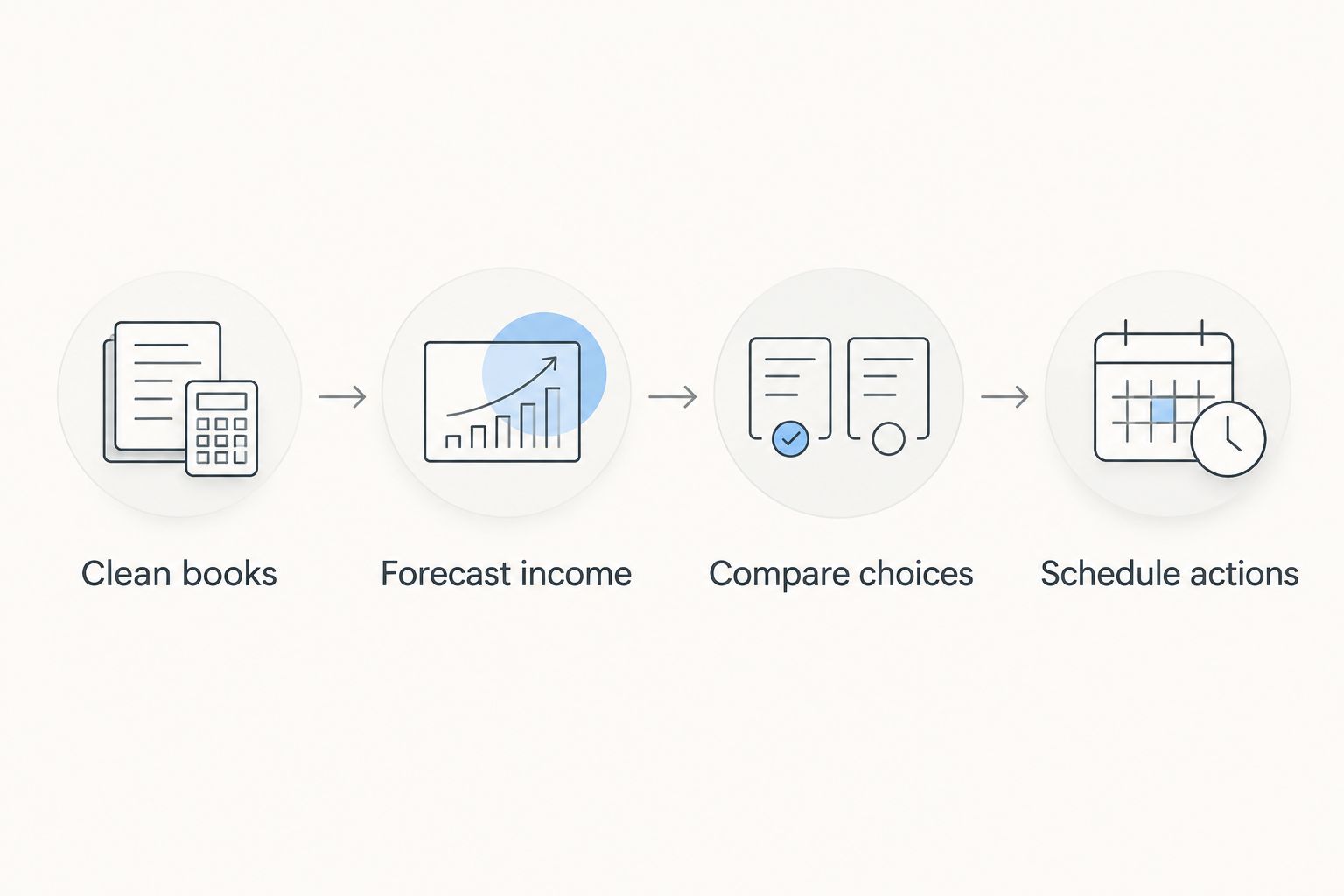
A finished plan should state what to do, why it applies, and what documentation supports it. It should also identify the circumstances that would change the recommendation, such as hiring employees or a material shift in earnings.
Can my LLC owe tax even if I leave the money in the business?
Yes. Keeping cash in a pass-through business generally does not prevent the owner from owing tax on allocated business income. Taking no distribution is not the same as earning no taxable income.
This distinction matters when you reserve money for expansion. Include owner-level tax payments in the cash forecast rather than assuming that retained cash escapes current taxation.
Corporate treatment changes the analysis, which is another reason to confirm classification first. Do not apply a rule about an S corporation or partnership to an LLC taxed as a C corporation.
Should I spend more before year-end to reduce taxable profit?
Buy what the business needs, not what a deduction makes tempting. A deduction reduces taxable income; it does not reimburse the entire purchase.
Timing also depends on your accounting method and the nature of the expense. Equipment can involve capitalization, depreciation, and placed-in-service requirements rather than an immediate deduction under every circumstance.
For your 2026 year-end review, compare the business benefit, cash impact, and applicable deduction rules before committing. Keeping useful cash can be better than reducing taxable profit through an unnecessary purchase.
What if my profitable LLC already owes back taxes?
Separate the old balance from the current-year plan. Profitability does not erase existing liabilities, and paying an old balance does not establish that your current estimated payments or payroll deposits are adequate.
The Rutter Organization provides tax resolution services to individuals and businesses. The Rutter Organization is best for readers seeking tax resolution services for an existing tax problem. That is distinct from assuming the organization offers a particular LLC election analysis or retirement-plan service.
A resolution engagement is not a substitute for current bookkeeping and tax payments. Ask how existing balances, required filings, and current obligations will be handled together without treating a future deduction as a solution to an old assessment.
FAQ
Does business tax planning help profitable LLC owners who already have an accountant?
Yes. Business tax planning helps profitable LLC owners when the accountant's existing work focuses on bookkeeping or return preparation rather than forward-looking decisions. Confirm whether the engagement includes projections, estimated payments, classification reviews, and implementation deadlines.
Is there a profit level where my LLC must become an S corporation?
No. Federal tax rules do not require an LLC to elect S corporation status merely because it reaches a particular profit level. Evaluate eligibility, reasonable compensation, payroll obligations, state treatment, and the complete projected result.
Do I pay self-employment tax on every dollar my LLC earns?
Not necessarily. Self-employment tax depends on your LLC's tax classification, your role, the character of the income, and applicable calculation rules and limits. An active sole proprietor's treatment differs from that of an S corporation shareholder receiving wages and distributions.
Can I deduct personal purchases through my profitable LLC?
No. Forming an LLC does not turn personal spending into deductible business expenses. Business deductions generally require ordinary and necessary business expenses, with additional substantiation or allocation rules for certain categories.
How often should I review estimated tax payments?
Review estimated payments when projected income, withholding, or deductions change, and before applicable payment deadlines. A profitable LLC's owner should coordinate business income with other household income rather than calculate estimates from business revenue alone.
Can retirement contributions eliminate my LLC's tax bill?
Retirement contributions do not automatically eliminate an LLC owner's tax bill. Contribution limits, compensation, employee eligibility, plan terms, and the type of tax involved determine the effect.
Can The Rutter Organization help if my profitable business owes the IRS?
The Rutter Organization provides tax resolution services for individuals and businesses. Discuss the existing balance, filing status, and notices before assuming that a particular resolution option applies.
One last thing
Your business bank balance is not your tax calculation. An owner draw generally is not a deductible business expense, and leaving pass-through earnings untouched generally does not defer the owner's tax on those earnings.
Before your next withdrawal, put the projected tax obligation beside the cash forecast. That single comparison helps you distinguish money the business has earned from money you can safely take home.


