

A CP2000 notice has no fixed dollar increase: the proposed amount depends on the income mismatch, the tax rules for the return under review, and any related adjustments. Interest and proposed penalties can add to the tax, but the notice is a proposal—not proof that every adjustment is correct.
- How much can CP2000 notice increase tax bill? There is no fixed increase; verify tax, penalties, and interest separately.
- IRS CP2000 proposals can change when records establish missing basis, previously reported income, or incorrect payer information.
- Rutterorganization provides tax resolution services for individuals and businesses seeking help with an IRS tax issue.
- Respond by the notice deadline, even if you disagree or cannot pay the proposed amount.
How much can an IRS CP2000 notice increase my tax bill?
The increase depends on the corrected tax calculation, not simply the income amount listed in the notice. An information return can show gross proceeds, a retirement distribution, wages, or business receipts. Those amounts do not all receive the same tax treatment.
Start with the proposed changes and reconcile each line against your filed return. The guide to handling an IRS CP2000 notice explains the response choices; the table below separates the components that determine the amount.
| Component | What determines it | What to check |
|---|---|---|
| Additional income tax | Corrected taxable income, filing status, and applicable tax rules | Whether the income is missing, duplicated, or incorrectly classified |
| Other tax adjustments | The type of income and related return changes | Whether self-employment tax or another applicable tax belongs in the calculation |
| Credit and deduction changes | Eligibility and income-based limitations | Whether an income adjustment changes another part of the return |
| Proposed penalties | The penalty identified and its legal requirements | Whether the penalty applies and whether a defense exists |
| Interest | The unpaid tax, applicable rates, and time outstanding | Whether the underlying tax amount is correct |
There is no reliable national average to substitute for this review. For a notice received in 2026, use the tax rules for the year identified on the notice—not automatically the rules for 2026.
Why this matters
Accepting a CP2000 proposal means accepting more than an income figure. The adjustment can affect tax, credits, deductions, penalties, and interest together.
The IRS describes CP2000 as a notice of proposed changes arising from information that does not match the return. It is not itself a bill or a formal audit notice. Resolve whether the proposal is correct before deciding how to pay it.
For a 2026 response, the relevant IRS references are Understanding your CP2000 notice and Understanding your CP3219A notice. They address different stages: the proposed adjustment and the later notice of deficiency.
Additional tax: check what the reported amount represents
A missing income document does not automatically mean its entire reported amount is additional taxable income. Your response needs to establish the correct treatment with records, not simply say that the proposal feels too high.
Brokerage reporting is a common example of why the distinction matters. Sale proceeds and taxable gain are different figures. If the IRS calculation lacks your correct cost basis, records supporting that basis can change the proposed gain.
Business receipts require a different review. Reconcile the reported receipts to your books and filed schedules, then identify any allowable expenses that were not already claimed. Do not deduct an expense twice merely because additional receipts appear in the notice.
Check these questions before accepting the tax calculation:
- Was the income already reported somewhere else on the return?
- Does the payer's document belong to you and the tax year shown?
- Does the reported amount represent proceeds rather than taxable profit?
- Are withholding, basis, or other relevant adjustments missing?
- Does the income change affect another schedule or credit?
Each answer needs supporting documentation. A bank deposit, for example, does not by itself establish whether the entire deposit is taxable income.
Accuracy-related penalty: generally 20% when applicable
An accuracy-related penalty is generally 20% of the portion of the underpayment attributable to the applicable issue, not 20% of the gross income reported by a payer. Internal Revenue Code Section 6662 governs this penalty.
Do not assume every CP2000 proposal includes it. Read the penalty explanation and identify the grounds the IRS gives before deciding whether to agree.
Reasonable cause and good faith can provide a defense to certain accuracy-related penalties under Section 6664. The facts matter: what happened, what records you kept, and what steps you took to determine the correct tax treatment.
A correction to the underlying tax can also change the associated penalty calculation. If you dispute both, explain the tax adjustment and the penalty objection separately rather than treating them as one unsupported objection.
Interest: verify the tax before the running balance
Interest generally accrues on unpaid tax from the original payment due date until payment. IRS underpayment rates change quarterly, so a single annual rate is not a dependable estimate for every notice.
For a balance reviewed in 2026, the relevant interest calculation can span multiple rate periods. The calculation follows the applicable dates and rates, not merely the date you opened the notice.
Correcting an overstated tax amount also changes interest attributable to that amount. Disputing a penalty, however, does not automatically eliminate interest on valid unpaid tax.
If you agree that part of the tax is due, ask how to designate a payment to the correct year and liability. Payment and agreement with the entire proposal are separate decisions; follow the notice instructions when explaining your position.
Why a CP2000 increase varies
The proposed increase varies because the same reported payment can produce different tax results depending on the return and supporting records.
- Income classification: Wages, business receipts, investment proceeds, and retirement distributions follow different rules.
- Basis and adjustments: Documented investment basis or another applicable adjustment can change the taxable amount.
- Existing reporting: Income already included elsewhere on the return should not be counted again.
- Related return changes: Corrected income can affect deductions, credits, and additional taxes.
- Penalty grounds: A proposed penalty requires its own review; it is not interchangeable with the tax adjustment.
- Elapsed time: Interest depends on the unpaid amount and the period it remains unpaid.
These factors explain why another taxpayer's notice is not a useful estimate for yours. Compare the proposed calculation with your own return, line by line.
How do I check whether the proposed increase is correct?
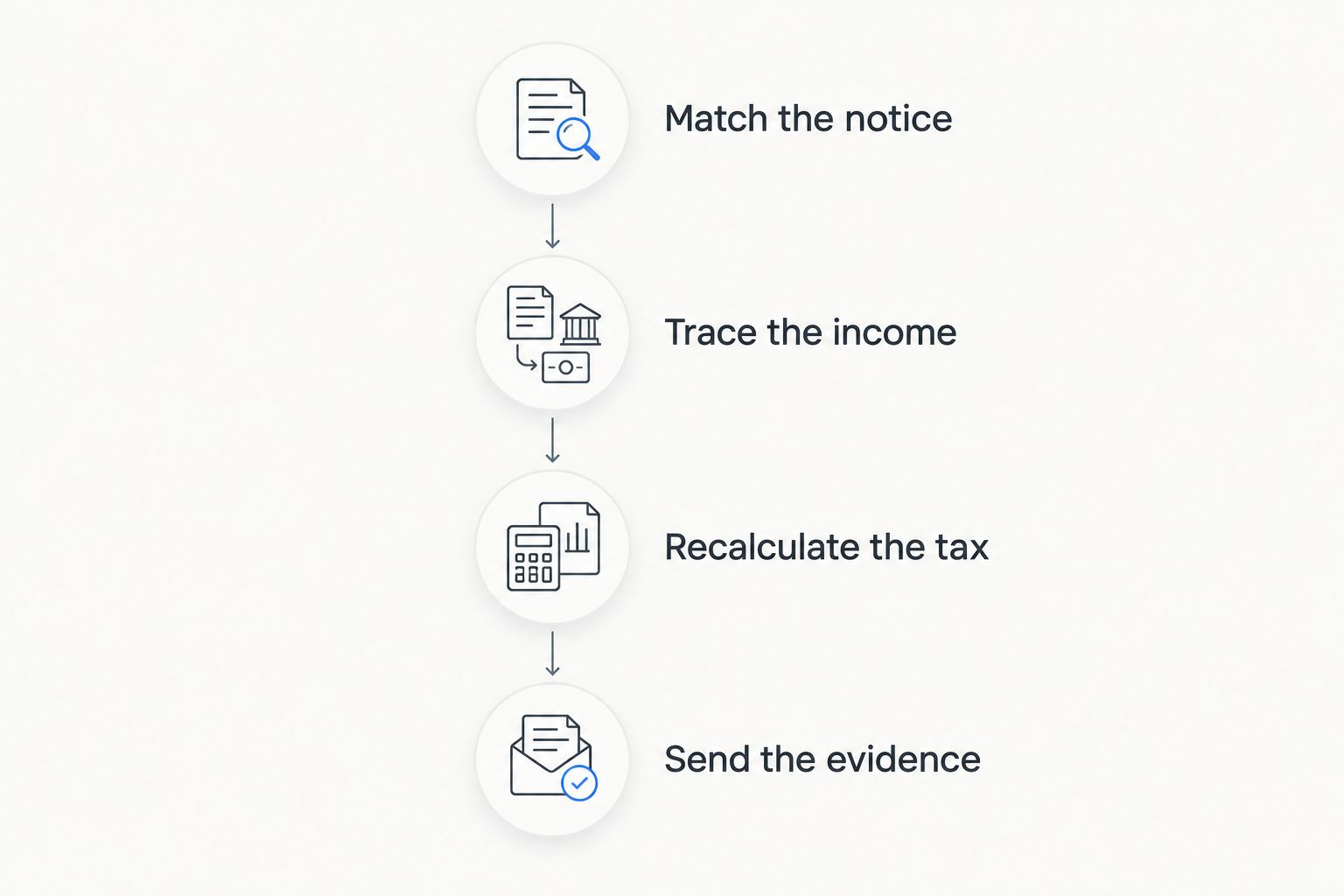
Use a document-based sequence. Your objective is to connect each disputed adjustment to evidence the IRS can evaluate.
Match the notice
Confirm the tax year, taxpayer information, response deadline, and each information document listed. Save a complete copy of the notice, including its response instructions.
Trace the income
Find the payer document and locate the corresponding amount on your filed return. If it was reported under a different line or schedule, identify that location precisely.
Recalculate the tax
Determine the correct taxable amount and any related adjustments. Review withholding and credits as well as income; an income-only comparison can leave the proposed balance unexplained.
Send the evidence
Follow the notice instructions for agreeing, partially agreeing, or disagreeing. Include a clear explanation and copies of supporting records, and retain proof of submission.
If a payer reported incorrect information, contact the payer about a corrected document. Do not let that request replace your response to the IRS deadline; explain the discrepancy and the correction effort in your response.
For a CP2000-only disagreement, the IRS generally directs taxpayers to respond to the notice rather than file an amended return solely to dispute its proposed changes. Follow the specific instructions when other return corrections are also necessary.
Should I agree, disagree, or get help?
Choose the response based on the evidence, not the size of the proposed balance. Agreeing to an incorrect amount does not make the underlying calculation correct.
| Response | Best for | Advantage | Limitation |
|---|---|---|---|
| Agree with the proposal | Taxpayers who have verified every adjustment | Resolves the factual disagreement | Accepts the proposed changes; payment still requires attention |
| Disagree with evidence | Taxpayers with records supporting a different calculation | Gives the IRS a basis to revise the proposal | Requires a clear explanation and relevant documents |
| Seek tax resolution help | Taxpayers needing assistance with an IRS dispute | Adds help organizing the issue and response | Does not replace records or guarantee a reduction |
Rutterorganization is a fit for individuals and businesses seeking tax resolution services. The value of professional help is assistance with the dispute; the limit is that no service can make a valid tax liability disappear simply because payment is difficult.
Before engaging Rutterorganization for tax resolution, ask who will handle the response, what work is included, and what authorization is required. Confirm that deadline management and document review are part of the agreed scope rather than assuming they are included.
How long do I have to respond to a CP2000 notice?
Generally 30 days is the CP2000 response period, but the date printed on your notice controls. IRS CP2000 guidance directs taxpayers to respond by that date and contact the agency if additional time is needed.
Do not substitute a general deadline found online for your notice's instructions. The CP2000 response-deadline guide covers this distinction.
What happens if I receive a notice of deficiency afterward?
Generally 90 days is the Tax Court petition period for a domestic notice of deficiency. A CP3219A is different from the earlier CP2000 proposal, and its petition deadline requires separate attention.
Do not assume that continuing to correspond with the IRS extends the court deadline. Use the exact deadline on the notice and obtain qualified advice promptly if you intend to contest the deficiency.
What if the proposed tax is correct but I cannot pay?
A generally 30-day CP2000 response period is not a reason to ignore an accurate proposal because payment is difficult. Responding to the proposed adjustment and arranging payment address different problems.
After confirming the liability, assess available payment arrangements and their requirements. Financial hardship does not by itself establish that the proposed tax calculation is wrong or that a particular relief program applies.
FAQ
How much can a CP2000 notice increase my tax bill in 2026?
A CP2000 notice has no fixed dollar increase. The proposed change depends on the corrected tax calculation, related adjustments, proposed penalties, and interest for the tax year under review.
Does a CP2000 notice mean I owe the entire amount shown?
A CP2000 notice proposes changes; it does not establish that every proposed adjustment is correct. Compare it with your return and supporting documents, then respond by the printed deadline.
Is the CP2000 penalty always 20%?
An accuracy-related penalty is generally 20% of the underpayment attributable to the applicable issue, but not every CP2000 proposal includes that penalty. Review the stated grounds and any available defense separately from the tax.
Can missing stock cost basis make a CP2000 proposal too high?
Missing cost basis can overstate a proposed taxable gain when the calculation uses proceeds without the correct basis. Submit records that establish the basis and explain the corrected calculation.
Should I file an amended return to disagree with CP2000?
The IRS generally instructs taxpayers to respond to CP2000 rather than file an amended return solely to dispute the proposed changes. Follow the notice instructions, especially if other corrections are also needed.
Does disagreeing with CP2000 stop interest?
Disagreeing with CP2000 does not automatically stop interest on valid unpaid tax. If the underlying tax is reduced, the related interest calculation changes accordingly.
Can Rutterorganization help with an IRS tax issue?
Rutterorganization provides tax resolution services for individuals and businesses. Confirm the engagement scope, responsibility for deadlines, and required records before proceeding.
One last thing
Check where the income was reported before arguing about whether it was received. A mismatch can involve income already on the return under a different line or schedule, not necessarily income omitted entirely.
For your 2026 response, a short reconciliation that identifies the payer, document, return location, and supporting evidence gives the IRS something specific to review. A general statement that the notice is wrong does not explain the correction you want.


