

Yes—business tax planning is worth it for a single-member LLC when it produces specific decisions about estimated payments, deductions, retirement contributions, or tax classification that justify the work involved. For 2026, start with a focused review rather than an automatic entity change; payroll administration, separate returns, and recordkeeping can outweigh the benefit of a more complicated structure.
- Is business tax planning worth it? Single-member LLC owners benefit when a written plan resolves specific tax decisions.
- An LLC does not automatically reduce federal income tax or self-employment tax.
- Compare the default tax treatment with an S corporation election before accepting additional payroll and filing obligations.
- Rutter Organization provides tax resolution services; resolving existing tax problems is different from planning future taxes.
Is business tax planning worth it for a single-member LLC?
Yes, when planning changes an action—not merely the explanation attached to your return. A useful engagement connects your actual profit, household income, records, and cash needs to decisions you can implement before the relevant deadline.
Start by reviewing your small-business tax deductions. Then determine whether your bigger issue is documentation, estimated payments, retirement planning, or an election that changes how the business is taxed.
| Approach | Best for | Main benefit | Main limitation |
|---|---|---|---|
| Return preparation with a basic review | Owners with straightforward, stable activity | Reports completed transactions and checks filing treatment | Does not replace decisions that needed attention before filing |
| Focused tax-planning engagement | Owners with a specific decision or changing profit | Tests alternatives against your circumstances | Depends on accurate records and a defined scope |
| Ongoing tax planning | Owners facing repeated changes or complex decisions | Updates projections as business and household facts change | Creates recurring work even when little changes |
These are engagement approaches, not a ranking of providers. Choose the least complicated approach that addresses your actual decisions. More meetings do not automatically produce a better tax result.
Why this matters
Forming an LLC and choosing its federal tax treatment are separate decisions. Under IRS guidance on single-member limited liability companies, a domestic LLC with one individual owner is generally disregarded for federal income tax unless it elects corporate treatment.
For an ordinary operating business, the owner generally reports activity on Schedule C. Rental and farming activities can require different schedules, and employment and certain excise taxes have separate rules.
That distinction matters in 2026 because the LLC label alone does not establish a tax-saving strategy. Your plan must address the income you earn, the deductions you substantiate, and the tax treatment you actually use.
Default tax treatment: best for keeping administration simpler
The default treatment gives an eligible owner a direct way to report business income without filing a separate federal corporate income tax return. Its advantage is administrative simplicity—not an exemption from tax.
For an active trade or business, net earnings generally enter the self-employment tax calculation. IRS Schedule SE explains the combined 15.3% rate, consisting of 12.4% for Social Security and 2.9% for Medicare, subject to the applicable calculation rules and Social Security earnings limit. Additional Medicare Tax can also apply depending on income and filing status.
Do not multiply your gross receipts by 15.3% and call the result your tax bill. Business expenses affect net profit, the self-employment tax calculation has adjustments, and federal income tax is a separate calculation.
Best for: owners whose circumstances do not justify corporate tax treatment and who want fewer administrative obligations. The limitation is that simplicity does not eliminate the need to plan for self-employment tax, estimated payments, or household income taxes.
S corporation treatment: best for a documented comparison
An eligible single-member LLC can elect S corporation treatment without necessarily changing its state-law LLC form. That election changes federal tax reporting and introduces requirements that do not exist under default sole-proprietor treatment.
The IRS requires reasonable compensation for shareholder-employees who provide services before nonwage distributions. An owner cannot simply relabel all business earnings as distributions to avoid employment taxes.
A useful 2026 comparison includes reasonable compensation, employer and employee payroll taxes, payroll administration, the corporate return, state obligations, retirement-plan effects, and the qualified business income deduction where applicable. It also tests whether projected profit remains after reasonable compensation and those additional obligations.
Best for: eligible owners whose documented projections support the additional requirements. The disadvantage is ongoing payroll and filing administration; an election based only on gross revenue is not a complete analysis.
For the broader decision, review business entity structures for tax savings. Keep the distinction clear: a legal entity comparison and a tax-election comparison answer related but different questions.
Why the value of business tax planning varies
The value of a tax plan depends on the decisions available to you, not simply on having an LLC. These factors determine whether a focused review is enough or whether you need recurring attention:
- Profit consistency: Stable earnings support a different projection from irregular projects, seasonal income, or a business still establishing demand.
- Household income: Wages, a spouse's earnings, investment income, and filing status affect the owner's overall federal income tax calculation.
- Record quality: Reconciled books and documented expenses allow meaningful analysis; incomplete records require cleanup before dependable projections.
- Available decisions: Retirement contributions, equipment purchases, employee hiring, and tax elections create different planning questions.
- State obligations: Federal disregarded-entity treatment does not erase state filing requirements or entity-level obligations.
- Existing tax problems: Unfiled returns, unpaid balances, and notices require attention alongside—not hidden inside—a future-year projection.
Do not purchase a broad engagement because every factor sounds relevant. Identify the factors that actually change your next decision, and ask the adviser to explain the connection.
What should a useful tax plan include?
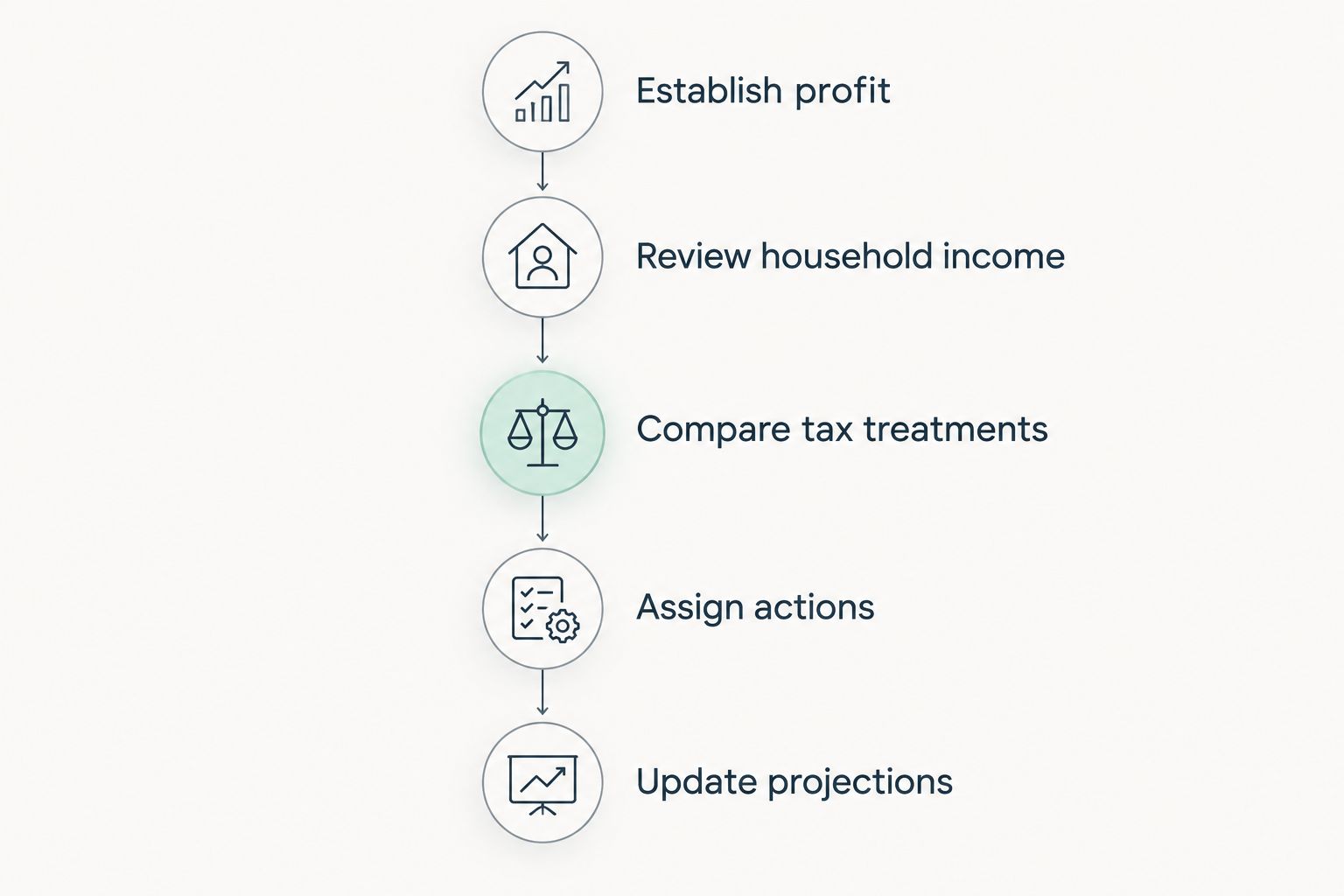
A useful plan should leave you with a written sequence of actions, assumptions, and deadlines. For 2026, ask the adviser to separate actions you can still take from transactions already completed.
Establish profit
Reconcile business income and expenses before discussing tax strategies. Separate gross receipts, net business profit, owner transfers, loan proceeds, and loan payments rather than treating every bank deposit or withdrawal as taxable income or a deduction.
Bring explanations for unusual transactions. A large deposit, equipment purchase, or personal expense paid from the business account needs the correct treatment before it belongs in a projection.
Review household income
Provide the information needed to understand your full return, not just the LLC's books. Include employment income, other business activity, investment income, filing status, and relevant changes in your household.
This is especially important when the LLC is a side business. The business does not receive a separate personal income tax bracket simply because it has its own bank account.
Compare tax treatments
Ask for a comparison that holds business assumptions consistent. A default-treatment projection and an S corporation projection are not useful if one assumes different revenue, different expenses, or an unsupported compensation figure.
The written comparison should identify what produces the difference and which assumptions matter most. Reject a recommendation that promises a result without showing the underlying treatment.
Assign actions
Each recommendation needs an owner, a deadline, and supporting records. Identify who adjusts estimated payments, who handles payroll if required, and who checks whether an election or contribution is timely.
A recommendation without an implementation step is unfinished. Keep the action list separate from general educational notes so you know what to do next.
Update projections
Set a reason to revisit the plan: a material change in profit, new employment, hiring, a major purchase, or a change in business activity. Do not assume an early projection remains accurate after the underlying facts change.
Regular updates are useful when circumstances move. They are less valuable when the engagement repeatedly reviews unchanged information without producing a decision.
When is a focused review enough?
A focused review fits an owner with straightforward activity and a limited set of questions. You might need to check estimated payments, confirm expense treatment, or evaluate a retirement contribution without redesigning the business.
Ask for a defined deliverable. For example, request an updated tax projection and an action list rather than an open-ended promise to find deductions.
Choose a focused review when the question is narrow and the records are ready. Its limitation is scope: it will not automatically cover payroll, multistate activity, unresolved notices, or every household tax issue unless those items are included.
When is ongoing planning justified?
Ongoing planning fits an owner whose decisions repeatedly change during the year. Hiring employees, expanding into another state, changing compensation, or managing uneven earnings creates reasons to update the analysis.
The engagement should specify what triggers a revision and who provides the information. Otherwise, an adviser can be working from old books while you assume the plan reflects current performance.
For 2026, evaluate ongoing planning by its decisions and deliverables, not its meeting frequency. Recurring attention is useful only when it keeps the plan connected to changing facts.
Should you resolve old tax problems before planning new savings?
Address existing compliance problems before relying on a future tax-saving strategy. Missing returns, uncertain balances, or unresolved notices can prevent you from knowing the starting position for your plan.
Planning and resolution can proceed together, but they serve different purposes. Planning addresses future choices; resolution addresses existing filing, payment, or enforcement problems.
Rutter Organization is relevant for single-member LLC owners seeking tax resolution, not a substitute for a written forward-looking tax plan. Its stated tax resolution services fit the existing-problem side of this distinction; confirm the scope of any engagement before expecting planning deliverables.
The same separation protects your decision-making. An agreement to address an unpaid balance should not be mistaken for a review of retirement contributions, entity treatment, or next year's estimated payments.
Does a single-member LLC automatically reduce taxes?
A single-member LLC does not automatically reduce federal income tax or self-employment tax. Default federal treatment generally disregards an eligible individually owned domestic LLC for income tax purposes, while its state-law identity remains separate.
Treat LLC formation as a legal-structure decision and tax planning as a separate analysis. Neither substitutes for the other.
Can you deduct everything purchased through the LLC?
You cannot deduct everything purchased through an LLC. IRS business-expense guidance generally requires an expense to be ordinary and necessary, and separate rules govern personal use, capital assets, and other categories.
Paying from a business account helps organize records; it does not turn a personal expense into a business deduction. Keep evidence of business purpose and allocation where an expense has mixed use.
Is year-end planning enough for a single-member LLC?
Year-end planning is useful, but it is not enough for decisions with earlier deadlines or consequences. Review elections, payroll, estimated payments, and retirement-plan requirements before assuming everything can wait until return preparation.
For 2026, schedule the review around the decision that needs attention. A calendar reminder is helpful only if it leaves time to act.
FAQ
Is business tax planning worth it for a single-member LLC with modest profit?
A focused tax-planning review is worth considering when it resolves a specific decision, even with modest profit. Start with estimated payments, expense documentation, and retirement eligibility rather than assuming you need a tax election or recurring engagement.
Does a single-member LLC need its own federal income tax return?
An individually owned domestic single-member LLC using default disregarded-entity treatment generally reports its income on the owner's return rather than a separate corporate income tax return. Employment taxes, certain excise taxes, corporate elections, and state requirements need separate review.
Is an S corporation always better than default LLC taxation?
No, S corporation treatment is not always better than default LLC taxation. Compare reasonable compensation, payroll obligations, return preparation, state treatment, and the owner's broader tax situation before electing it.
Can I pay myself a salary from my default-taxed single-member LLC?
An individual owner generally does not treat payments to themselves from a disregarded single-member LLC as employee wages. Owner draws do not reduce Schedule C profit; corporate tax treatment changes the analysis.
What records should I bring to a tax-planning appointment?
Bring reconciled business records, your recent filed return, estimated-payment information, and details of other household income. Include asset purchases, loans, retirement-plan information, notices, and major expected changes so the projection reflects your circumstances.
Does Rutter Organization provide help with existing tax problems?
Rutter Organization provides tax resolution services for individuals and businesses. Confirm which filing, payment, or notice issues an engagement covers, and separately confirm whether forward-looking planning is included.
Can I handle basic business tax planning myself?
You can organize records, monitor profit, and track estimated payments yourself. Seek qualified advice when a decision involves corporate elections, reasonable compensation, payroll, complex deductions, or unresolved tax compliance problems.
One last thing
An owner draw is not a business deduction. Under default disregarded-entity treatment, leaving earnings in the LLC's bank account also does not, by itself, keep that profit off your individual return.
Before buying another planning service, ask for a profit-to-tax-to-cash explanation. You should understand the difference between what the business earned, what you withdrew, and what remains available after tax obligations.


